TL;DR:
- Avoiding common Spanish mistakes helps learners sound more natural and builds confidence quickly.
- Focusing on ser, estar, gender agreement, verb tenses, subjunctive, and false cognates eliminates most frequent errors.
Avoiding common Spanish mistakes is the fastest way to sound more natural and build real confidence in conversation. Learners who target five specific areas, including ser/estar, gender agreement, verb tenses, subjunctive mood, and false cognates, can eliminate roughly 80% of their most frequent errors. Estudio Sampere and Language Trainers both confirm that these categories trip up English speakers more than any others. This guide breaks down each mistake with clear examples and direct fixes so you can stop repeating the same errors and start speaking Spanish that native speakers actually understand.
Five key grammatical areas account for the vast majority of errors English speakers make in Spanish. Knowing which areas to focus on saves you from spreading your practice too thin.
The five areas are:
Each of these categories produces errors that native speakers notice immediately. Fixing them one at a time, rather than all at once, is the most efficient path to fluency.
Pro Tip: Build a short daily drill around just one of these five areas each week. Focused repetition beats scattered review every time.
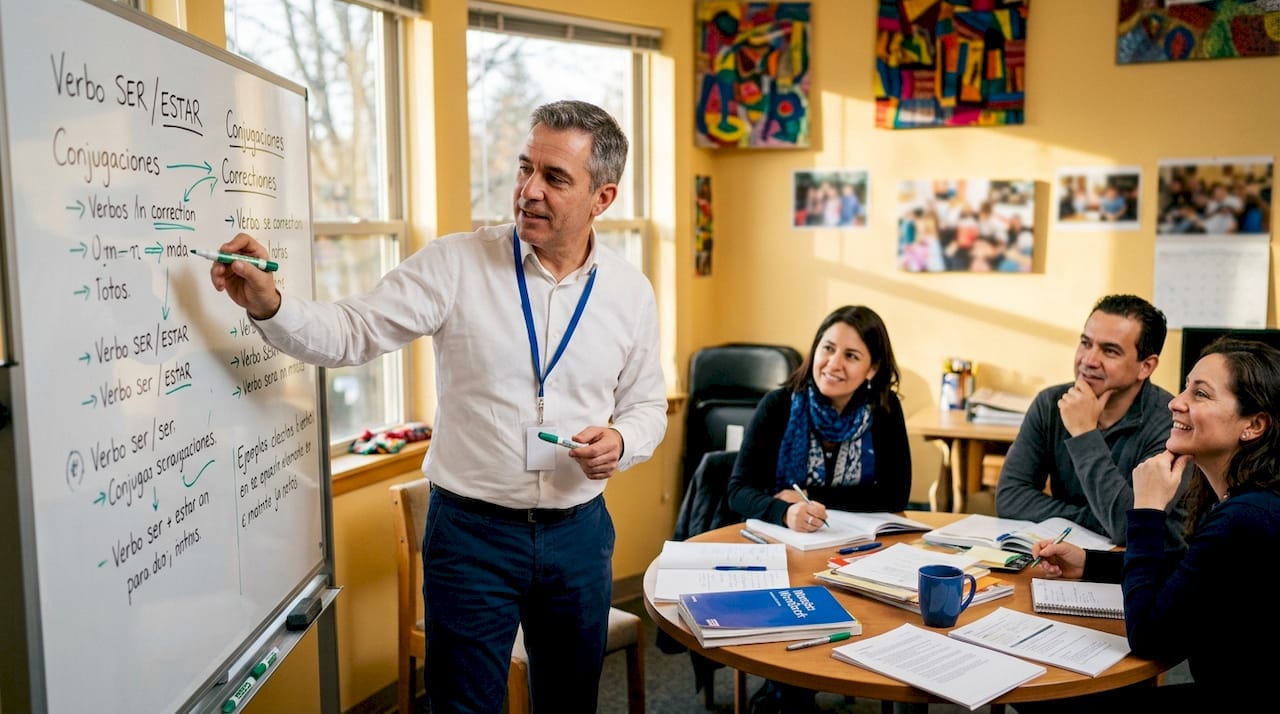
Confusing ser and estar is the number one hurdle for English speakers learning Spanish. English has one verb, “to be,” but Spanish splits that function across ser, estar, and even tener in certain contexts.
Use ser for permanent or defining traits: nationality, profession, and identity. Use estar for temporary states, emotions, and physical locations. The sentence “Soy aburrido” means “I am a boring person.” The sentence “Estoy aburrido” means “I am bored right now.” One word swap changes your entire meaning.
The confusion goes further. Age expressions require tener, not ser or estar. “Tengo 30 años” is correct. “Soy 30 años” is a clear grammatical error that signals a beginner immediately.
Pro Tip: When you are unsure which verb to use, ask yourself: “Is this a permanent trait or a temporary state?” That single question resolves most ser/estar decisions.
False cognates are words that look or sound like English words but carry completely different meanings in Spanish. Misusing false cognates leads to statements that are confusing, inappropriate, or outright embarrassing.
Here are the most important ones to know:
False cognates carry cultural nuances that go beyond simple vocabulary. Context determines meaning, and a dictionary alone will not always save you.
Pro Tip: Keep a personal list of false cognates you encounter. Reviewing ten of them weekly builds the habit of checking context before assuming a word means what it looks like.
Verb tense errors are among the most disruptive frequent Spanish errors because they change the timeline and meaning of what you say. The preterite and imperfect tenses are the biggest source of confusion.
The preterite describes completed actions with a clear endpoint. “Ayer comí una pizza” means “Yesterday I ate a pizza.” The imperfect describes ongoing past states or repeated actions. “De niño, comía pizza todos los viernes” means “As a child, I used to eat pizza every Friday.” Using preterite where imperfect belongs, or vice versa, produces sentences that confuse native speakers about when and how something happened.
The subjunctive mood creates a separate layer of difficulty. It expresses wishes, doubts, emotions, and hypothetical situations. Learners often skip it entirely and use the indicative instead.
The subjunctive “estudie” is required after “quieren que” because it expresses a desire, not a fact. Skipping the subjunctive makes your Spanish sound flat and unnatural to any native speaker. Practicing verb moods in full sentences, not just conjugation tables, is the fastest way to internalize the difference. A structured approach to learning Spanish grammar gives you the context drills that make these distinctions stick.
Spanish assigns a grammatical gender to every noun, and gender agreement errors are audible markers of non-native speech. The article, noun, and adjective must all agree in both gender and number.
A classic example is “la problema.” The word “problema” ends in “a” but is masculine. The correct form is “el problema.” Other masculine words ending in “a” include “el mapa,” “el día,” and “el idioma.” Assuming that words ending in “a” are always feminine is one of the most common traps for English speakers.
| Incorrect | Correct | Reason |
|---|---|---|
| la problema | el problema | “Problema” is masculine despite the “a” ending |
| el mano | la mano | “Mano” is feminine despite the “o” ending |
| un agua fría | un agua fría | Feminine noun uses “un” before a stressed “a” sound |
| los libros rojas | los libros rojos | Adjective must match noun gender (masculine) |
The fix is to learn every noun with its article from the start. Do not memorize “problema” alone. Memorize “el problema” as one unit. This habit, built early, prevents fossilized grammar errors that become very hard to correct later. Reviewing beginner Spanish grammar rules with this approach gives you a solid foundation from day one.
Literal translation from English is a major source of errors that confuse native Spanish speakers. English and Spanish structure sentences differently, and mapping one language onto the other produces unnatural results.
A common example is the English phrase “to look for.” Learners often say “mirar para” because “mirar” means “to look” and “para” means “for.” The correct Spanish verb is “buscar,” a single word with no preposition needed. The same problem appears with “to listen to” (escuchar, not “escuchar a” in most cases) and “to ask for” (pedir, not “preguntar para”).
The deeper issue is that English speakers approach Spanish expecting one “to be” verb, one structure for expressing age, and direct phrase-by-phrase equivalence. Spanish does not work that way. Building a practical communication workflow that trains you to think in Spanish, rather than translate from English, removes this problem at the root.
Learners understand rules theoretically but often fail to apply them in real conversation under pressure. The gap between knowing a rule and using it automatically is where most persistent errors live.
This is the fossilization problem. When incorrect patterns go uncorrected long enough, they become automatic habits. Saying “soy cansado” instead of “estoy cansado” feels natural after months of repetition, even though it is wrong. Early correction is far more efficient than relearning after a mistake has become a habit. This is why structured feedback from a qualified instructor matters more than self-study alone at the intermediate stage.
The solution is not more grammar study. The solution is guided speaking practice where errors are caught and corrected in real time. A consistent Spanish language practice workflow built around speaking, not just reading exercises, breaks the fossilization cycle before it sets in.
Mastering the five core error categories, starting with ser/estar and false cognates, removes the majority of mistakes that mark non-native Spanish speech and prevents them from becoming permanent habits.
| Point | Details |
|---|---|
| Five areas drive most errors | Ser/estar, gender, tenses, subjunctive, and false cognates cover roughly 80% of common mistakes. |
| False cognates cause real embarrassment | Words like “embarazada” and “estoy caliente” carry meanings that differ sharply from their English look-alikes. |
| Subjunctive cannot be skipped | Ignoring the subjunctive mood produces flat, unnatural Spanish that native speakers notice immediately. |
| Learn nouns with their articles | Memorizing “el problema” as a unit prevents gender agreement errors from becoming automatic habits. |
| Early correction beats relearning | Fixing errors in the early stages is far more efficient than correcting fossilized habits later. |
The most surprising thing about teaching Spanish to adults is how predictable the errors are. Every learner, regardless of background, hits the same five walls in roughly the same order. Ser and estar come first. Gender agreement comes second. The subjunctive arrives later and stops almost everyone cold.
What conventional advice gets wrong is the emphasis on grammar rules over cultural instinct. You can memorize every ser/estar rule and still say “estoy caliente” in the wrong context because you learned the vocabulary without the cultural weight attached to it. The fix is not more rules. The fix is more exposure to how native speakers actually use the language, in real sentences, real conversations, and real situations.
The learners who progress fastest are not the ones who study the hardest. They are the ones who get corrected the most, early and often, by someone who knows what to listen for. Fossilized errors are genuinely difficult to undo. I have seen intermediate learners spend months trying to stop saying “soy cansado” because nobody corrected them in their first ten lessons. That is a fixable problem, but only if you address it before the wrong pattern becomes automatic.
My honest advice: do not wait until you feel “ready” to speak. Speak now, make the mistakes, and get them corrected before they harden into habits. The goal is not perfect Spanish. The goal is Spanish that keeps improving.
— Paul
Spanish Explorer offers adult Spanish courses in Singapore designed around exactly the mistakes covered in this article. Certified instructors correct errors in real time, which is the single most effective way to stop repeating them.

Whether you prefer online Spanish classes via Zoom or in-person group and private sessions at International Plaza above Tanjong Pagar MRT, Spanish Explorer structures every lesson around practical communication. The curriculum covers conversational and business Spanish for adults, with flexible schedules that fit working professionals. Browse the full range of adult Spanish courses or book a trial class to see the teaching approach firsthand.
Confusing ser and estar is the most common error. English speakers expect one “to be” verb, but Spanish uses ser, estar, and tener across different contexts.
Memorize every noun with its article as a single unit, for example “el problema” rather than just “problema.” This habit prevents gender errors from becoming automatic.
False cognates are Spanish words that resemble English words but carry different meanings. “Embarazada” means pregnant, not embarrassed, and “sensible” means sensitive, not sensible.
English rarely uses a distinct subjunctive form, so learners have no instinct for it. Spanish requires the subjunctive after expressions of desire, doubt, and emotion, making it a frequent source of communication errors.
With consistent guided practice and real-time correction, most learners reduce their core grammar errors significantly within three to six months. Structured instruction accelerates that timeline compared to self-study alone.
Book a trial class and see how quickly you can progress with a professionally trained native-speaker teacher guiding the way.
Book a Trial Class Spanish