TL;DR:
- Singapore uses English as the primary medium for teaching Spanish to ensure better comprehension and resource access.
- Bilingual strategies and contrastive analysis with English improve Spanish grammar understanding and fluency.
- English proficiency of teachers is crucial for effective explanations, classroom management, and student success.
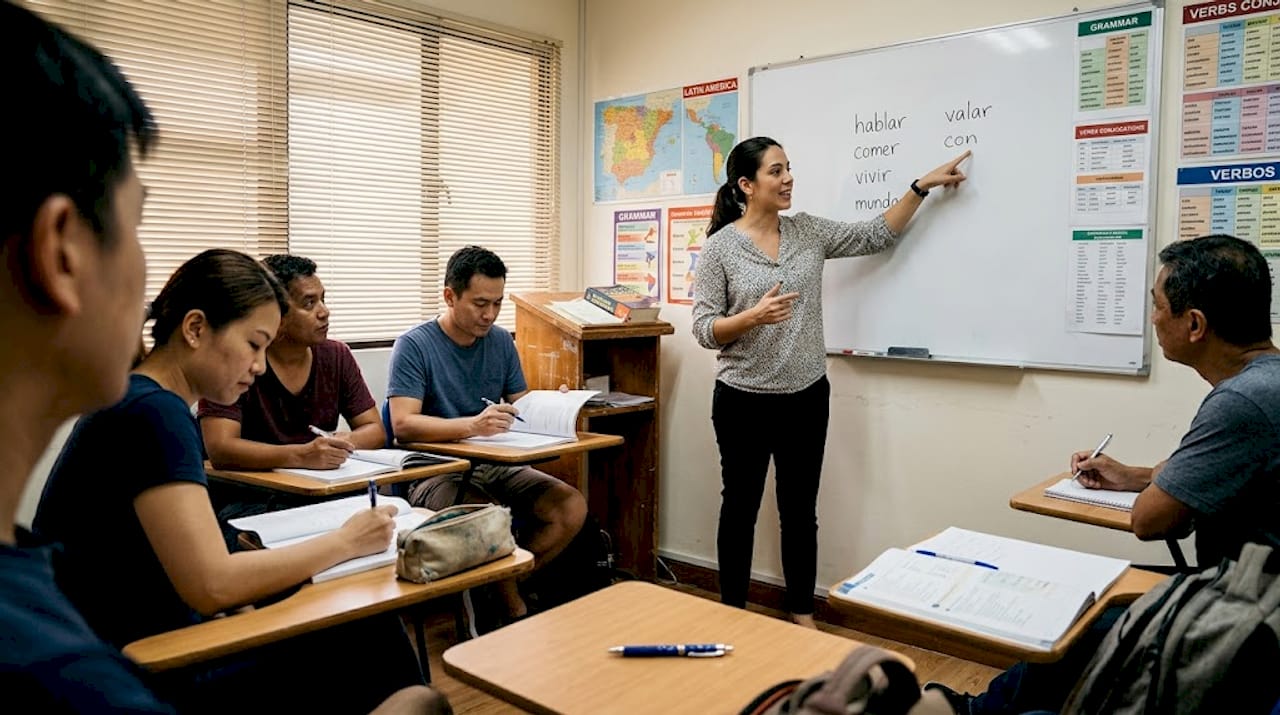
Most people assume Spanish class means Spanish only. In Singapore, the reality is far more nuanced, and the evidence suggests that is actually a good thing. English serves as the primary medium of instruction across Singapore’s education system, including for foreign languages like Spanish. Rather than hindering fluency, this approach unlocks faster comprehension, better grammar awareness, and stronger speaking skills. This article walks through the research, the classroom strategies, and the practical tools that make English an unexpected but powerful ally in Spanish instruction across Singapore.
| Point | Details |
|---|---|
| English is central | Singapore uses English as the main language to teach Spanish due to its national educational policy. |
| Teacher proficiency matters | Spanish teachers need strong English skills for clear instruction and classroom management. |
| Bilingual methods boost outcomes | English-Spanish teaching strategies enhance comprehension and speaking skills over monolingual methods. |
| Contrastive analysis improves accuracy | Comparing English and Spanish helps learners catch grammar issues and produce better Spanish. |
| Singapore’s model offers global lessons | The evidence-based integration of English in Spanish instruction can inform other multilingual environments. |
When students learn Spanish in Singapore, they are almost always taught in English. This is not a workaround or a compromise. It reflects the deliberate structure of Singapore’s education system, where English serves as the primary medium of instruction across Singapore’s education system for all subjects, including foreign language courses.
Singapore’s population is multilingual, with residents speaking Mandarin, Malay, Tamil, and dozens of other languages at home. English, however, is the shared academic language that cuts across all communities. Using it as the instructional medium for Spanish creates a level playing field. Every student, regardless of their mother tongue, accesses Spanish through the same linguistic lens.
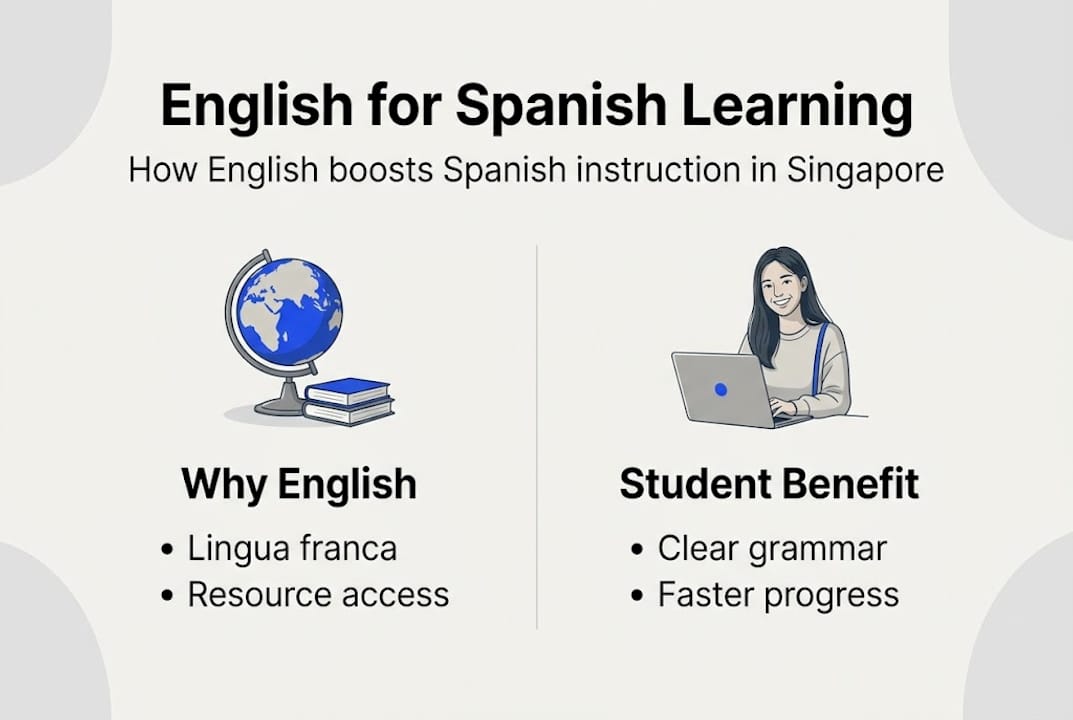
This also has a practical upside. English-language resources for learning Spanish are among the most abundant in the world. Textbooks, grammar guides, online courses, and standardized exams like the DELE are all widely available in English. When a Spanish class in Singapore is conducted in English, students can tap into this global ecosystem of learning materials without translation barriers.
Here is a quick look at how English-medium Spanish instruction compares across different learning contexts:
| Context | Instructional language | Key benefit |
|---|---|---|
| MOE Language Centre | English | Consistent access, clear grammar explanation |
| Private language schools | English | Bridges diverse learner backgrounds |
| Immersion programs abroad | Spanish only | Maximum exposure, faster naturalization |
| Online self-study platforms | English | Flexibility, resource abundance |
The benefits of English-medium Spanish instruction include:
“Singapore’s English-dominant environment makes English the natural bridge language for introducing Spanish, giving learners a stable cognitive anchor as they build new linguistic skills.”
This foundation shapes everything from how teachers are hired to how lessons are designed.
If English is the medium of instruction, then the teacher’s English ability matters just as much as their Spanish fluency. Spanish teachers in Singapore require working knowledge of English at a minimum CEFR B2 level, which means they can discuss complex topics, explain abstract grammar concepts, and manage a classroom effectively in English.

This requirement exists for good reason. A teacher who struggles to explain the difference between preterite and imperfect tenses in English will lose students fast. Clear metalinguistic explanation, the ability to describe how language works, is one of the most valuable tools in a Spanish instructor’s kit.
Here is how English proficiency levels map to classroom effectiveness for Spanish teachers in Singapore:
| English CEFR level | Classroom capability | Outcome for students |
|---|---|---|
| B1 (Intermediate) | Basic instructions, limited grammar explanation | Gaps in understanding complex structures |
| B2 (Upper-Intermediate) | Full classroom management, grammar metalanguage | Strong comprehension, effective corrections |
| C1 (Advanced) | Nuanced explanations, cultural context, debate | Deep engagement, higher accuracy |
| C2 (Mastery) | Native-level precision in all explanations | Maximum clarity and learner confidence |
Bilingual teaching strategies, where the teacher moves fluidly between Spanish and English, produce measurably better outcomes. Students understand new concepts faster, retain vocabulary longer, and feel less anxious about making mistakes.
Pro Tip: If you are evaluating a Spanish course, ask whether the instructor holds a recognized teaching certification and can explain Spanish grammar in clear English. That combination is a strong predictor of learning success.
Here are the key ways English proficiency directly improves Spanish instruction:
The bilingual classroom is not a fallback. It is a feature.
Research into Spanish instruction in Singapore has produced some genuinely striking findings. Flipped learning improves Spanish speaking interaction skills for A2-level students at the MOE Language Centre, with students who prepared using English-language video content at home arriving to class ready to practice speaking rather than absorbing new grammar.
The flipped classroom model works like this: students watch or read English-medium explanations of new Spanish content before class. Class time is then freed up entirely for Spanish speaking practice, pair work, and communicative tasks. The result is more actual Spanish production per lesson, not less.
Key finding: Students in flipped learning groups showed higher Spanish speaking interaction scores compared to traditional instruction groups, demonstrating that English-supported preparation directly boosts Spanish output.
Beyond flipped learning, general empirical evidence supports bilingual approaches (L1/English + target language) over monolingual Spanish-only instruction for comprehension and retention. This is particularly true for adult learners and those at beginner to intermediate levels.
Effective bilingual strategies used in Singapore Spanish classrooms include:
For learners wondering how long this approach takes to show results, a clear Spanish learning timeline can help set realistic expectations based on your starting level and learning frequency.
Online learners benefit equally. Online Spanish classes that integrate English explanations with Spanish practice sessions replicate the bilingual classroom environment effectively, even remotely.
The evidence is clear: English is not the enemy of Spanish fluency. Used strategically, it is one of the fastest routes to it.
One of the most underused tools in Spanish instruction is contrastive analysis, a method where learners directly compare English and Spanish to identify where the two languages diverge. Contrastive analysis between English and Spanish via translation improves grammatical accuracy and raises learner awareness of structural differences that cause persistent errors.
For Singapore learners, this is especially valuable. English-speaking learners consistently make the same categories of mistakes in Spanish: false cognates (words that look similar but mean different things), incorrect gender assignment for nouns, and misuse of verb tenses. Contrastive analysis makes these patterns visible before they become habits.
Pro Tip: Build a personal error log. Every time you make a grammar mistake in Spanish, write the incorrect sentence, the correct version, and the English equivalent. After two weeks, patterns will emerge that are unique to your learning profile.
Corpus-based tasks, where learners examine large collections of real Spanish text to see how native speakers actually use certain structures, are particularly effective when paired with English comparison. Students can see, for example, that Spanish speakers rarely use certain literal translations of English phrases, and adjust their own production accordingly.
Key areas where contrastive analysis adds the most value for Singapore learners:
Understanding Spanish language differences between regional varieties also benefits from this contrastive approach, helping learners choose the right vocabulary and pronunciation for their goals.
Contrastive analysis turns English from a potential crutch into a precision tool.
The loudest voices in language education often push for full immersion: speak only Spanish from day one, avoid the mother tongue at all costs. That philosophy has merit in some contexts. But it overlooks the specific realities of Singapore’s learning environment.
Singapore learners are already operating in a multilingual cognitive space. Mandarin, English, and often a third language are all active simultaneously. Pretending English does not exist in the Spanish classroom does not create immersion. It creates confusion.
In Singapore’s English-dominant context, English facilitates Spanish instruction through metalinguistic scaffolding, resource access, and bilingual strategies that produce measurable gains. This is not a beginner’s shortcut. Advanced learners benefit from English-based grammar analysis, translation work, and contrastive tasks well into their studies.
The real risk is over-reliance, not use. A well-designed course uses English strategically and reduces that scaffolding as learner proficiency grows. By the time students reach B2 level, English explanations become rare. The structure is already internalized.
Singapore’s approach offers a practical model for any multilingual society where a shared lingua franca exists. Rather than fighting the learner’s existing linguistic toolkit, smart instruction builds on it. That is not compromise. That is good pedagogy, and Spanish class in Singapore reflects exactly this thinking.
If you are ready to apply these evidence-based strategies to your own Spanish learning journey, Spanish Explorer is built for exactly this.

Spanish Explorer’s certified instructors are fluent in both Spanish and English, applying the bilingual teaching methods and contrastive analysis techniques discussed throughout this article. Whether you prefer group sessions, private coaching, or the flexibility of online Spanish courses, there is a format that fits your schedule and goals. Explore the full range of Spanish courses in Singapore and find the right starting point for your level, whether you are a complete beginner or preparing for a DELE exam.
English is the main medium of instruction for all subjects in Singapore, including Spanish, because it serves as the shared academic language across the country’s multilingual population. English serves as the primary medium of instruction across Singapore’s education system, making it the natural bridge for introducing foreign languages.
Spanish teachers must hold at least a CEFR B2 level of English to explain grammar concepts clearly, manage classrooms effectively, and support diverse learners. Spanish teachers in Singapore require working knowledge of English as a core professional requirement.
Yes. General empirical evidence supports bilingual approaches (L1/English + target language) over monolingual Spanish-only instruction, showing better comprehension and skill retention, especially for beginner and intermediate learners.
Contrastive analysis between English and Spanish via translation helps learners spot recurring grammatical errors and understand structural differences between the two languages, leading to more accurate Spanish production over time.
Book a trial class and see how quickly you can progress with a professionally trained native-speaker teacher guiding the way.
Book a Trial Class Spanish