In the Spanish language, greetings play a fundamental role in establishing connections and social interactions, whether in formal or informal settings. In Spanish-speaking countries, the way you address someone can depend on the situations and the relationship you have with the person.
In more formal situations, it is common to use greetings like “Buenos días” or “Buenas tardes” followed by a “¿Cómo está usted?” or “¿Cómo le va?” as a polite way to ask how the other person is doing. This is the most courteous way to ask “How are you?” in Spanish, especially in professional settings or with older individuals.
In everyday and informal contexts, it is more common to use expressions like “¿Qué tal estás?” or “¿Cómo estás?” to ask how someone is feeling. Other informal greetings include “¿Qué tal?”, “¿Qué pasa?”, or “¿Qué hay?”, which are more common among friends and in relaxed situations.
It is important to note that the response to these greetings may vary depending on the level of formality. Responses like “Estoy bien, gracias” or “Todo bien” are useful for both formal and informal situations. However, in a more casual context, responses may be more relaxed, such as “Muy bien, ¿y tú?” or even “Pura Vida” in some Latin American countries.
In this guide, you will know the difference between saying “How are you in Spanish?” in both formal setting and informal setting. Stick around until the end.

In Spanish-speaking cultures, formality plays a crucial role in greetings, especially in formal settings such as professional environments or when addressing someone of higher authority or respect. Formal greetings demonstrate courtesy, respect, and professionalism.
Here are some common ways to ask “How are you?” in formal settings:
These formal greetings are appropriate in a more formal setting, including:
Using these formal greetings demonstrates your respect and professionalism in Spanish-speaking environments. It’s essential to understand when to use formal language to ensure appropriate communication in various social and professional contexts.
Below is a summary of the Spanish words to say “how are you” in Spanish language formally:
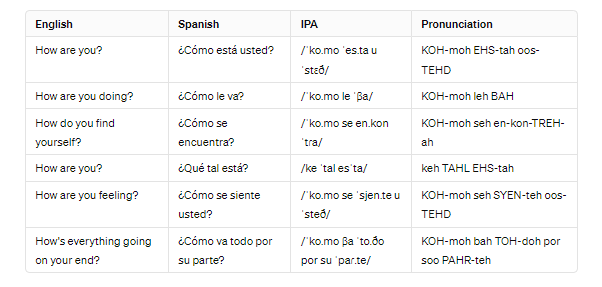

In Spanish, informal greetings reflect a sense of familiarity and casualness between individuals. These greetings are commonly used among friends, family members, and acquaintances in relaxed settings.
Here are some common ways to ask “How are you?” informally in Spanish:
These informal greetings are appropriate for everyday conversations among friends, family, classmates, and colleagues in informal settings such as:
Using these informal greetings helps establish a friendly and relaxed atmosphere in conversations and reflects the informal nature of the relationship between the speakers.
Below is a list of the Spanish words to say how are you in Spanish informally:
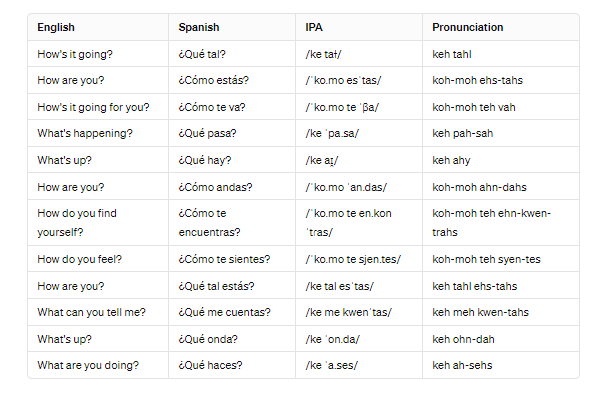
Moreover, here are some examples of saying how are you in Spanish slang:
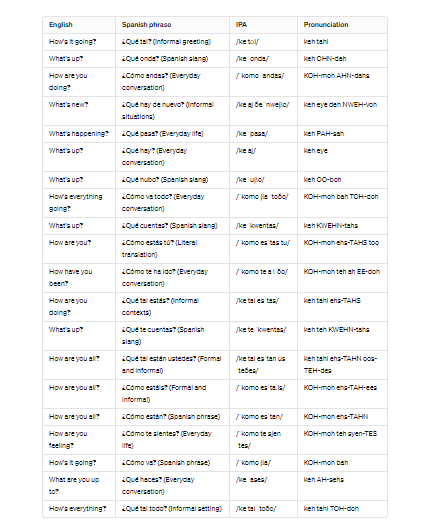

Responding to greetings in Spanish involves providing an appropriate and polite answer depends on the level of formality and the context of the conversation. In both formal and informal settings, it’s polite to reciprocate the question by asking “Y tú?” (And you?) or “¿Y usted?” (And you?) to show interest in the other person’s well-being. Additionally, expressing gratitude for asking, such as “gracias por preguntar” (thank you for asking), adds politeness to the response.
When responding to formal greetings in Spanish, it’s important to use a polite and respectful tone.
Here are some common appropriate responses for formal settings:
This response acknowledges the inquiry into your well-being and reciprocates the question to show interest in the other person’s state.
Similar to the first response, this one expresses gratitude for the concern and inquires about the other person’s condition in a respectful manner.
This response conveys that everything is going smoothly and appreciates the courtesy of asking about your well-being.
This response not only acknowledges your positive state but also shows interest in the other person’s situation, using a more formal tone.
This response acknowledges your well-being and respectfully inquires about the other person’s circumstances.
In formal settings, it’s important to respond with courtesy and respect, acknowledging the inquiry into your well-being and reciprocating the question to show genuine interest in the other person’s state. Expressing gratitude for asking (“gracias por preguntar”) adds politeness to the response.
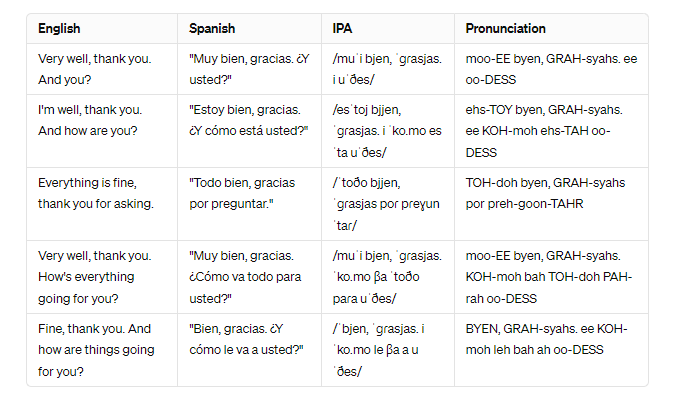
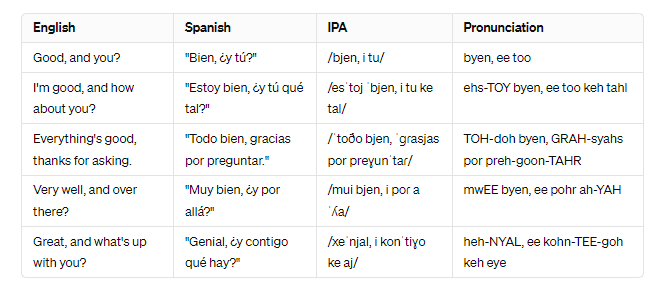
When responding to informal greetings in Spanish, it’s common to maintain a relaxed and friendly tone. Here are some common responses for informal settings:
This response acknowledges that you are doing well and returns the question to show interest in the other person’s well-being.
This response indicates that you’re feeling fine and invites further conversation by asking the other person how they are.
This response conveys that everything is going smoothly and appreciates the inquiry into your well-being.
This response indicates that you’re doing great and asks about the other person’s situation, using a more casual tone.
This response expresses that you’re feeling fantastic and inquires about what’s going on with the other person, using a friendly and informal tone.
In informal settings, it’s typical to respond with a casual and friendly demeanour, acknowledging your well-being and showing genuine interest in the other person’s state. Inviting further conversation by asking “¿y tú?” (and you?) or “¿y por allá?” (and over there?) helps maintain the flow of the conversation.
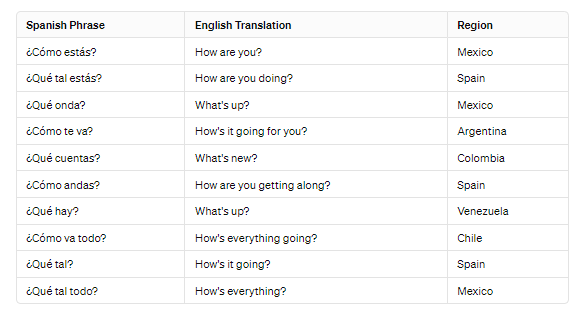
Cultural differences, historical factors, and linguistic evolution can influence regional variations in Spanish greetings. As a result, the way people ask “How are you?” may vary across different Spanish-speaking regions.
Here are some examples from various countries:
These examples demonstrate the diversity in greetings across Spanish-speaking countries, showcasing variations in both the wording and the informality of the expressions used. It’s important to be aware of these regional differences when communicating with Spanish speakers from different parts of the world.
Here is a list of more Spanish phrases, their literal translation and region:

To master Spanish greetings effectively, consider the following practical tips:
Practice Pronunciation: Focus on correctly pronouncing Spanish greetings to ensure clear communication. Listen to native speakers, use pronunciation guides, and practice speaking aloud to improve your pronunciation skills.
Understand Cultural Context: Learn about the cultural nuances surrounding Spanish greetings in different regions. Understanding when to use formal or informal greetings and the appropriate context for each can enhance your interactions with native speakers.
Recognize Formality Levels: Familiarize yourself with formal and informal forms of greetings in Spanish. Pay attention to the context and the relationship between speakers to determine the appropriate level of formality to use.
Expand Vocabulary: Expand your repertoire of greetings by learning additional phrases commonly used in Spanish-speaking countries. This includes informal greetings like “¿Qué tal?” and “¿Qué hay?” as well as formal greetings like “¿Cómo está usted?” and “¿Cómo le va?”
Immerse Yourself: Immerse yourself in the Spanish language and culture by practising greetings in real-life situations. Engage in conversations with native speakers, watch Spanish-language media, and explore cultural resources to reinforce your understanding of greetings in context.
Practice Regularly: Incorporate greetings into your daily language practice routine. Practice with flashcards, language apps, or language exchange partners to reinforce your knowledge and improve your fluency in using Spanish greetings.
By following these tips and actively incorporating Spanish greetings into your language-learning journey, you’ll build confidence and proficiency in greeting others in Spanish effectively.
In conclusion, greetings play a crucial role in Spanish culture, serving as the foundation for building relationships and establishing rapport. Understanding the importance of greetings in Spanish-speaking countries is essential for effective communication and cultural exchange.
Throughout this exploration, we’ve learned that there are various ways to ask “How are you?” in Spanish, with expressions ranging from formal to informal and varying across different regions. From the formal “¿Cómo está usted?” to the informal “¿Qué tal?” each greeting carries its own nuances and cultural context.
It’s important to recognize the significance of formality levels and regional variations when using Spanish greetings. By mastering pronunciation, understanding cultural context, and expanding vocabulary, learners can enhance their ability to greet others appropriately in Spanish.
Explore the rich diversity of Spanish greetings and practice using them in everyday interactions. Whether through language exchange partners, immersive experiences, or cultural resources, embracing Spanish greetings will not only improve language proficiency but also deepen cultural understanding and connection.
So, ¡adelante! (Go ahead!) Explore, practice, and enjoy the vibrant world of Spanish greetings. ¡Buena suerte! (Good luck!)
Ready to take your Spanish greetings to the next level? Immerse yourself in the language and culture with a comprehensive Spanish course in Singapore. We offer a variety of programs designed to boost your confidence and fluency in using Spanish greetings and communication in real-world scenarios!
Back to all articlesBook a trial class and see how quickly you can progress with a professionally trained native-speaker teacher guiding the way.
Book a Trial Class Spanish