TL;DR:
- Adults need structured grammar practice to build fluency, accuracy, and confidence in Spanish.
- Combining explicit rule learning with conversation practice accelerates mastery and reduces errors.
- Regular feedback from tutors or native speakers is key to overcoming common grammar mistakes.
Grammar is the part of Spanish learning that most adults in Singapore quietly dread. You can memorize vocabulary, follow along in a conversation, and even recognize phrases from a show you’ve been watching. But the moment you try to construct your own sentence, verb conjugations and gender agreements trip you up. This guide walks you through a practical, structured path to mastering Spanish grammar as an adult. Whether you’re studying for personal enrichment, a DELE exam, or professional advancement, the strategies here will help you build real accuracy and confidence.
| Point | Details |
|---|---|
| Blend structure and immersion | Combining structured grammar study with real-world practice builds true fluency. |
| Daily practice works best | Consistent 15-20 minute sessions lead to better long-term retention. |
| Feedback improves accuracy | Correction and advice from tutors or native speakers help you master tricky rules. |
| Celebrate milestones | Tracking progress keeps you motivated and highlights real improvement. |
Grammar is not just a set of rules you memorize and forget. It is the framework that holds every sentence together. Without it, you might get your point across, but you’ll sound uncertain and be misunderstood more often than you’d like. For adults learning Spanish in Singapore, grammar is often the gap between understanding what you hear and being able to produce accurate, natural speech yourself.
Adults face a specific challenge here. Younger learners absorb grammar intuitively through exposure. Adults, by contrast, tend to rely on logic and pattern recognition. That’s actually an advantage when it’s used correctly. You can understand why a rule works, not just that it works. But it also means you need more deliberate, structured exposure to grammar rather than hoping it sinks in through osmosis.
Here’s what solid grammar knowledge gives you:
There are ways to learn Spanish that blend grammar with communication practice, and that combination is what accelerates real progress. If you’ve ever wondered how challenging is Spanish for English speakers, the honest answer is that grammar is the steepest part of the curve, but it’s entirely manageable with the right approach.
Research backs this up. Effective methodologies blend structured grammar study with immersion, because apps alone build recognition but lack retrieval fluency. In other words, you might recognize a correct sentence when you see it, but you can’t produce one under pressure without deliberate grammar training.
“Immersion builds comprehension but needs explicit techniques for grammar accuracy.” This is why passive exposure through music, films, or travel alone rarely produces accurate speakers.
For a deeper look at how grammar and phonology interact in language learning, more about grammar and phonology is worth exploring as supplementary reading.
Knowing why grammar matters is step one. Now let’s talk about what you need in place before you start studying rules in earnest.
First, set realistic time expectations. Many learners underestimate how long proficiency actually takes. Reaching ILR 3 proficiency requires roughly 600 to 750 hours of study, while an A2 elementary level is achievable in 6 to 8 months with consistent daily practice.
| Proficiency level | Approximate study hours | Realistic timeline |
|---|---|---|
| A1 Beginner | 60 to 150 hours | 2 to 4 months |
| A2 Elementary | 150 to 300 hours | 6 to 8 months |
| B1 Intermediate | 300 to 500 hours | 12 to 18 months |
| ILR 3 Professional | 600 to 750 hours | 2 to 3 years |
Beyond time, your mindset matters enormously. Consistency beats intensity every time. Studying for 20 minutes every day produces better results than a three-hour session once a week. Patience is also non-negotiable. Grammar rules in Spanish, especially subjunctive mood and reflexive verbs, take time to internalize.
Here’s what to gather before you begin:
Choosing the right learning environment is also critical. Self-study works if you’re highly disciplined, but most adults benefit from the accountability and live correction that group classes or private tutoring provide. Structured fluency methods combine explicit grammar instruction with real conversation practice, which is the most effective setup for adult learners.
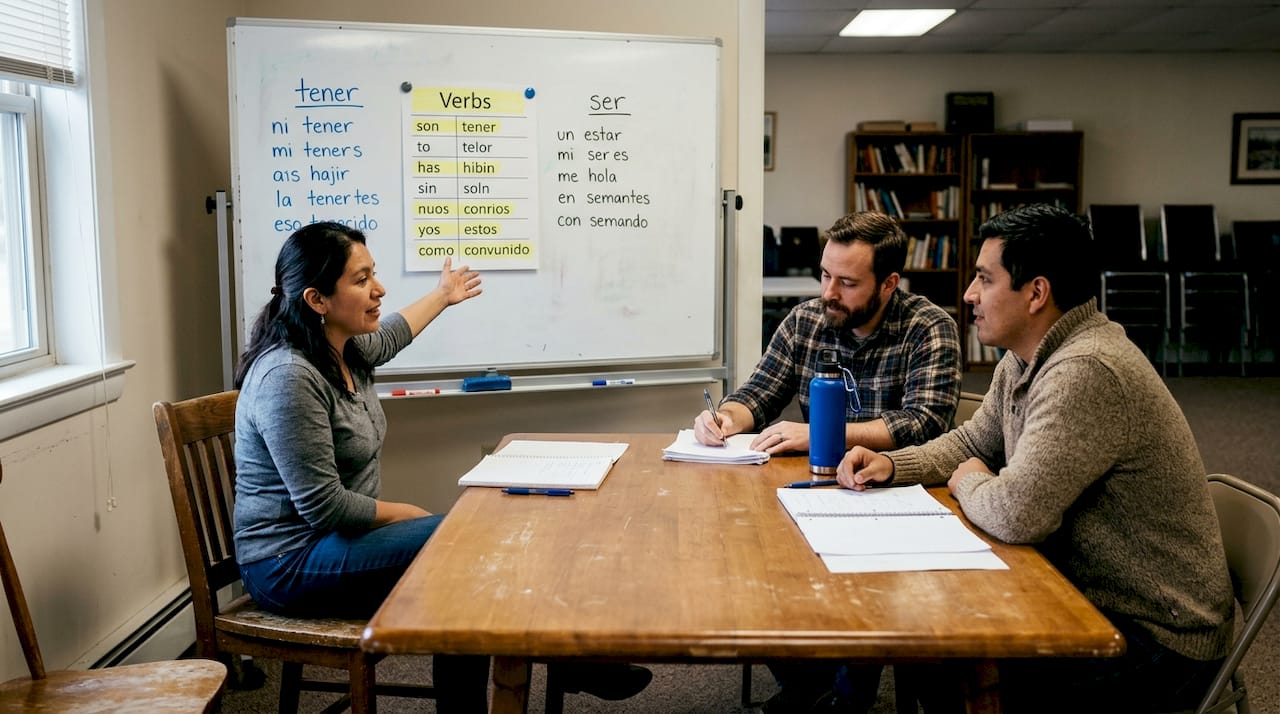
Pro Tip: Block out a fixed 15 to 20 minutes every morning for grammar study before your day gets busy. Research consistently shows that short, daily sessions outperform longer, irregular ones for grammar retention.
With your resources in place, here is a practical process that works for adult learners.
Here’s a quick comparison of the most common learning formats:
| Format | Grammar instruction | Speaking practice | Feedback quality |
|---|---|---|---|
| Apps (Duolingo, Babbel) | Basic recognition | Minimal | Automated only |
| Group classes | Structured and sequential | Regular | Live, from instructor |
| Private tutoring | Personalized and targeted | Intensive | Immediate and specific |
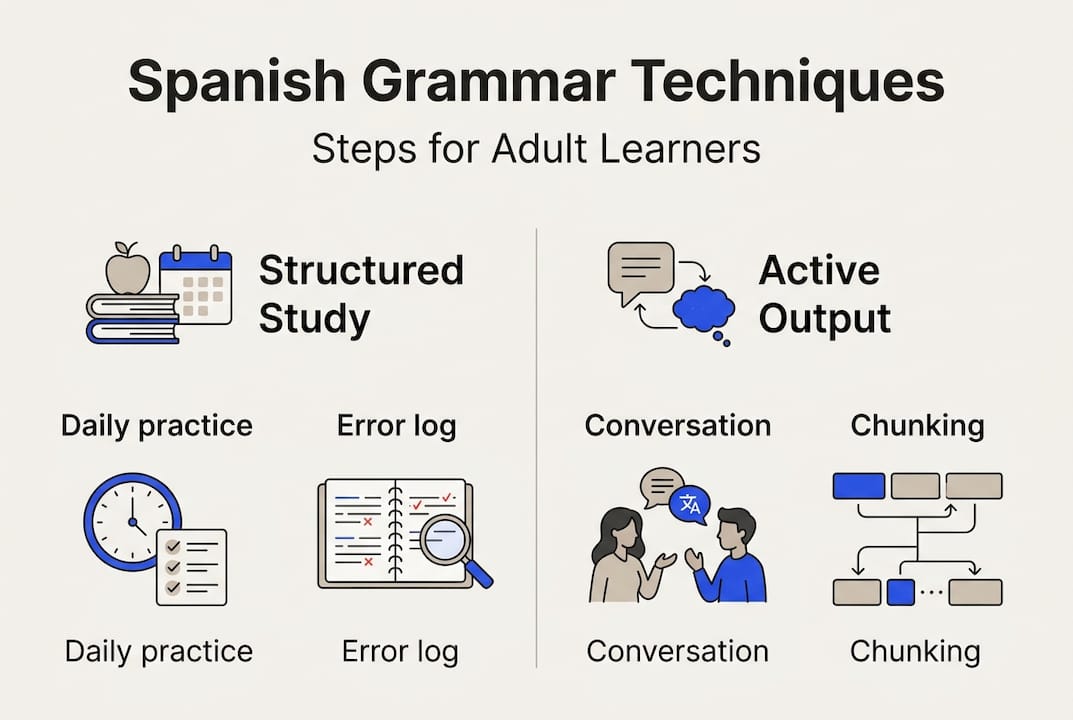
Mixing structured study with conversation is the key insight most learners miss. Grammar learned in isolation fades. Grammar applied in conversation becomes automatic. For a solid foundation, Spanish pronunciation basics also play a role in how confidently you apply grammar in speech.
Understanding language immersion theory helps explain why input alone isn’t enough. You need output practice, which means actually producing sentences, not just recognizing them.
Pro Tip: Use chunking to memorize grammar patterns. Instead of memorizing a rule abstractly, memorize a complete example sentence that uses it. Then adapt that sentence to new contexts. Spaced repetition review of these chunks every 3 to 5 days locks them into long-term memory.
Even with a solid routine, certain errors show up repeatedly for adult Spanish learners. Knowing them in advance saves you weeks of frustration.
The most common grammar mistakes include:
Adults are sensitive to gender errors and need explicit feedback to improve accuracy. This means self-correction alone is often not enough. You need someone to point out the error in real time.
The fix for most of these issues is intentional error tracking. Keep an error diary. Every time you make a mistake, log it with the correct version and a note about the rule. Review it weekly. This simple habit accelerates improvement dramatically.
Another powerful fix is seeking regular feedback from tutors or native speakers. A tutor who notices you consistently misusing the subjunctive can address it directly, rather than letting the habit calcify. It’s also worth understanding regional grammar differences between Latin American and Spain Spanish, since some rules and vocabulary vary across regions.
Finally, resist the urge to ignore errors in casual conversation. Noticing your mistakes, even in low-stakes settings, is what separates learners who plateau from those who keep improving.
Progress in grammar can feel invisible. You don’t always notice improvement day to day. That’s why setting clear benchmarks matters.
Here’s how to track your grammar progress effectively:
Celebrating small wins is not optional. It’s a strategy. When you nail a grammar concept that confused you for weeks, acknowledge it. That positive reinforcement keeps you going through the harder stretches.
The data is clear: structured courses boost vocabulary and conversation skills by 50% over unstructured efforts. That’s not a small difference. It’s the gap between a learner who plateaus at A2 and one who reaches B2 in a reasonable timeframe.
For motivation, consider joining a Spanish class online or a local language meetup group. Accountability partners and community keep you consistent when motivation dips. Progress trackers, whether a simple notebook or an app, also help you see how far you’ve come. For additional motivation strategies, record-time learning strategies offer practical techniques worth exploring.
After working with hundreds of adult learners in Singapore, one pattern stands out clearly: the learners who improve fastest are not the ones who watch the most Spanish TV or travel to Spain. They are the ones who study grammar deliberately and then practice it in real conversations.
The “immersion only” approach is a compelling idea, but it has a serious flaw for adults. Immersion alone is insufficient without explicit grammar work for accuracy and fluency. What we see in practice is that students who rely purely on immersion hit a plateau around A2 or B1. They understand a lot, but their output remains riddled with errors they don’t even notice.
The breakthrough comes when learners tackle grammar head-on, with structured lessons and live feedback. That’s when fluency stops being a distant goal and starts feeling achievable. Our recommendation is a hybrid approach: explicit grammar instruction through structured fluency methods, combined with regular conversation practice. This is what consistently produces confident, accurate Spanish speakers.
If you’ve read this far, you already know that structured learning beats guesswork. The next step is putting that structure in place with the right support.

At Spanish Explorer, our Spanish courses are designed specifically for adult learners who want real grammar accuracy, not just surface-level familiarity. Whether you prefer the energy of a group setting, the personalized pace of private Spanish lessons, or the flexibility of an online Spanish class, we have a format that fits your schedule and goals. Our certified instructors provide live feedback that accelerates your grammar progress in ways that no app can replicate. Book a trial class and start building the grammar foundation you need.
Reaching professional proficiency requires 600 to 750 hours, while basic grammar at the A2 level can be mastered in 6 to 8 months with consistent daily practice.
Apps build grammar recognition but fall short on retrieval fluency and live speaking practice, which are essential for real accuracy.
Immersion boosts comprehension, but explicit grammar instruction is necessary for producing accurate speech and writing.
Study for 15 to 20 minutes daily using structured materials, log your errors intentionally, and apply each grammar rule in real conversation for lasting retention.
Adults benefit from error correction and explicit feedback, making tutor input critical for improving accuracy with nuanced grammar rules.
Book a trial class and see how quickly you can progress with a professionally trained native-speaker teacher guiding the way.
Book a Trial Class Spanish