TL;DR:
- Adults have advantages like analytical thinking and a larger shared vocabulary that aid learning Spanish.
- Consistent daily active practice, using effective tools and realistic goals, accelerates progress significantly.
- Focus on high-value activities such as active recall, conversation, and pronunciation drills for faster fluency.
Spanish feels like a mountain when you’re already juggling a full-time job, family commitments, and a packed Singapore schedule. Many adults try a few apps, hit a wall after a month, and quietly conclude they’re “too old” or “not a language person.” That conclusion is wrong, and the research proves it. This guide pulls together the latest evidence-based strategies, practical tools, and realistic timelines so you can build genuine conversational Spanish skills without burning out. Whether you’re learning for travel, career growth, or personal satisfaction, the path is clearer than you think.
| Point | Details |
|---|---|
| Adults have real advantages | Adult learners can use their analytical skills to master Spanish faster with the right strategies. |
| Active learning boosts recall | Guessing and immediate feedback make new vocabulary stick more effectively than passive study. |
| Set realistic, motivating goals | Reaching conversational Spanish usually takes 4 to 7 months with steady effort and the right benchmarks. |
| Avoid common pitfalls | Blending apps with conversation practice and focusing on pronunciation speeds up learning and keeps motivation high. |
Let’s kill the biggest myth first: children are not better language learners than adults across the board. Yes, children absorb accents effortlessly. But adults bring something children simply don’t have: the ability to analyze patterns, apply rules consciously, and transfer knowledge from one language to another. That cognitive edge is enormous, and it’s one of the main reasons structured Spanish learning works so well for professionals.
Research confirms that adults excel with metalinguistic awareness, meaning they can analyze grammar rules faster than children can. The one genuine challenge for adults is pronunciation, where targeted drills are needed to rewire sound patterns that your brain has spent decades reinforcing. That’s a solvable problem, not a permanent barrier.
Here’s what adult learners actually have going for them:
“The adult brain isn’t worse at language learning. It’s just different. Use that difference strategically, and you’ll move faster than you expect.” — A principle echoed by linguists and language educators worldwide.
The key shift is adopting an active, not passive, approach. Passive exposure, like having Spanish TV on in the background, produces very little real gain for adults. Active strategies like guessing, recall, and immediate feedback produce dramatically better results. You can explore effective ways to learn Spanish that are specifically designed around how adult brains process new information.
Pro Tip: Don’t try to “think like a child” when learning Spanish. Lean into your adult strengths. Analyze sentence structure, look for patterns, and use your analytical mind as your greatest asset.
Pairing that mindset with step-by-step Spanish study plans gives you a clear roadmap from day one, which removes the guesswork and keeps your momentum steady.
With a positive outlook and realistic expectations, it’s time to assemble your toolkit and lay a practical foundation. The difference between learners who succeed and those who quit usually comes down to setup, not talent.
Essential tools for Singapore adult learners:
Building a sustainable routine:
Cramming on weekends doesn’t work for language acquisition. Your brain needs regular, spaced exposure to move vocabulary from short-term to long-term memory. Twenty to thirty minutes daily outperforms two hours on Saturday every single time. For Singapore adults, this means treating Spanish like a daily habit, not a weekly project.
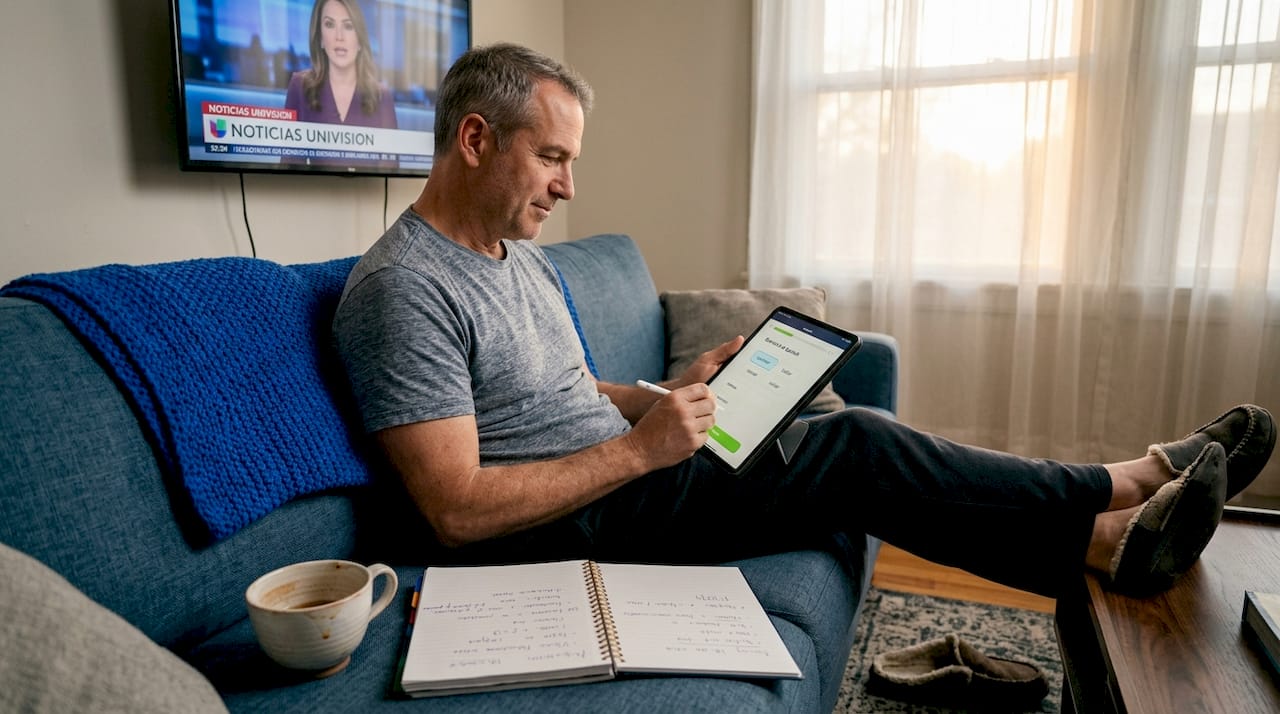
Here’s how CEFR benchmarks translate into real timelines for working adults studying one hour per day:
| CEFR Level | Hours Required | Time at 1 hr/day | What you can do |
|---|---|---|---|
| A1 | 70 to 150 hrs | 2 to 5 months | Basic greetings, simple phrases |
| A2 | 150 to 200 hrs | 4 to 7 months | Simple conversations, travel situations |
| B1 | 300 to 400 hrs | 10 to 13 months | Workplace communication, travel fluency |
| B2 | 500 to 750 hrs | 12 to 24 months | Professional proficiency, near-fluent conversation |
These numbers are encouraging. B2, which is professional-level proficiency, is achievable in under two years with consistent daily effort. That’s a realistic goal for most Singapore professionals.
Singapore-specific micro-learning tips:
Understanding efficient Spanish learning workflows helps you structure these micro-sessions into a coherent weekly plan rather than random bursts of effort.
Pro Tip: Aim for five sessions of 20 to 30 minutes spread across the week rather than two long weekend sessions. Frequency beats duration for language retention.
Reviewing Spanish learning timelines in detail also helps you set milestones that match your personal schedule and professional goals.
Once you’ve done the groundwork, here’s the research-backed process for making Spanish easier, faster, and more memorable.
Step 1: Start with high-frequency vocabulary using active guessing.
Before you look up a word’s meaning, try to guess it first. This sounds counterintuitive, but word-picture guessing with immediate feedback significantly improves vocabulary recall by engaging active memory search. Your brain works harder to retrieve the answer, which makes the correct meaning stick far longer than simply reading a translation.
Step 2: Pair every new word with context and spaced repetition.
Isolated vocabulary lists are weak. Pair each new word with a sentence, an image, or a story. Then schedule review sessions using spaced repetition. This combination encodes words into long-term memory far more reliably than any passive method.
Step 3: Blend input and output from week one.
Many learners spend months only consuming Spanish before they attempt to speak. That’s a mistake. From your very first week, combine:
This blend of input and output activates different parts of your brain and accelerates overall fluency.
Step 4: Choose resources that combine context, spacing, and audio.
Not all learning resources are equal. A recent comparison of learning methods found that Phrase Café scores 94 out of 100 for combining context, spacing, and audio, compared to standalone apps at 61 and traditional classes at 58 when used without supplementary practice.
| Resource type | Score (out of 100) | Strength | Weakness |
|---|---|---|---|
| Phrase Café (context+spacing+audio) | 94 | Full integration | Requires consistency |
| Language learning apps | 61 | Habit building | Plateau without output |
| Traditional classes alone | 58 | Grammar structure | Limited speaking practice |
| Audio-only courses | 72 | Listening and pronunciation | Weak on grammar |
Step 5: Use pronunciation drills from the start.
Don’t wait until you’re “fluent enough” to worry about pronunciation. Early drills build correct muscle memory. Check out Spanish pronunciation tips to practice the sounds that trip up English speakers most, like the rolled “r” and the difference between “b” and “v.”
Pro Tip: Record yourself speaking Spanish once a week. Listening back is uncomfortable but incredibly effective. You’ll catch errors your ears miss in real time and track genuine improvement over months.
Combining these steps gives you a method that’s grounded in research and adapted for proven ways to learn Spanish fast without sacrificing retention.
As with any skill, using the right method means little if you fall into common traps. Here’s how to avoid the most frequent ones.
Mistake 1: Relying solely on apps.
Apps are excellent for building daily habits. But apps alone foster habits and plateau without speaking output. Immersive practice compresses learning time by 40 to 50%, while pronunciation still needs targeted drills that most apps simply don’t provide. If Duolingo is your only tool, you’ll hit a ceiling around A1 to A2 and stay there.
Mistake 2: Avoiding speaking practice.
This is the most common mistake among adult learners in Singapore. Speaking feels embarrassing, so learners postpone it indefinitely. The result is strong reading skills but near-zero conversational ability. Start speaking from week one, even badly. Explore speaking practice ideas that are specifically designed for learners who don’t yet have a conversation partner.
Mistake 3: Overloading on grammar before communication.
Grammar is important, but drilling conjugation tables for weeks before attempting a real sentence kills motivation. Learn enough grammar to communicate, then use communication to reinforce grammar naturally. You can always deepen your understanding with targeted grammar learning techniques once you have a conversational base.
Mistake 4: Underestimating early wins.
The first time you understand a Spanish sentence without translating it in your head is a huge milestone. So is ordering coffee in Spanish, or following a short podcast episode. These moments matter. Celebrate them.
“The fastest way to quit learning Spanish is to measure yourself only against fluent speakers. Measure yourself against where you were last month, and you’ll always be winning.”
Quick fixes at a glance:
With obstacles identified and minimized, the next step is to ensure you keep moving forward by recognizing your victories, both big and small.
Set CEFR-aligned benchmarks.
The CEFR framework gives you clear, internationally recognized milestones. Reaching A1 means you can introduce yourself and ask basic questions. A2 means you can handle everyday situations like shopping or asking for directions. B1 means you can discuss familiar topics at work or while traveling. These aren’t vague goals. They’re concrete, measurable checkpoints.
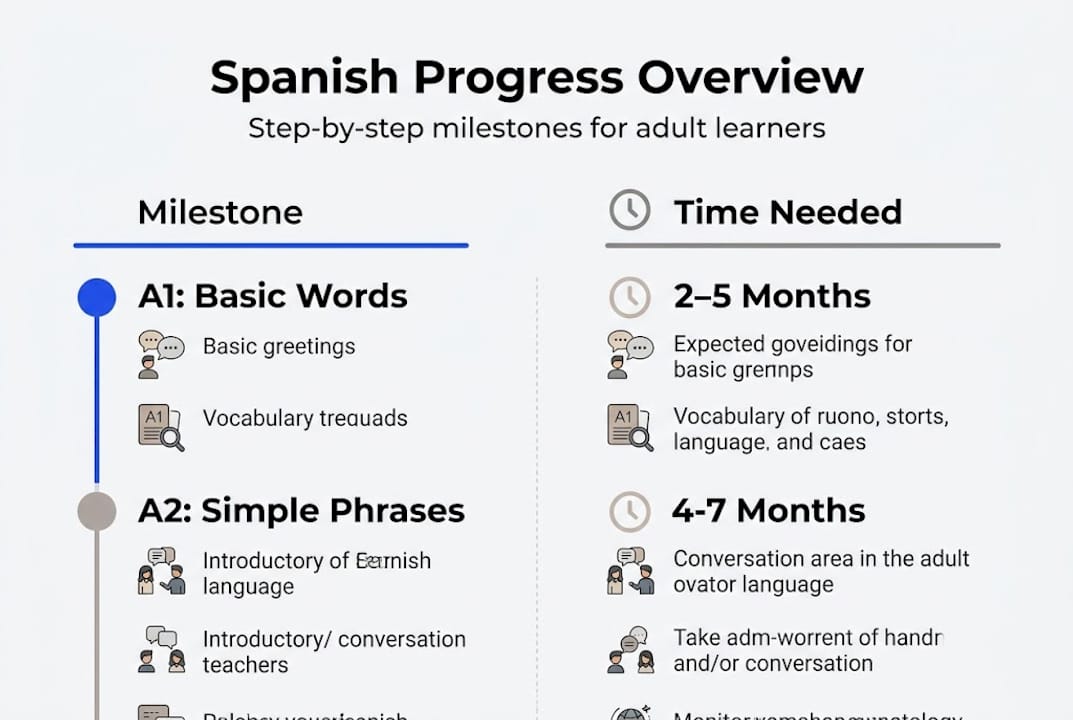
According to recent research, most adults reach A2 in 4 to 7 months studying one hour per day, and B2 in 12 to 24 months. That’s a realistic, achievable path for a Singapore professional who commits to a daily routine.
Use micro-goals to maintain momentum:
Document your progress concretely:
Checking your Spanish progress timeline regularly gives you a clear sense of where you are and how far you’ve come, which is one of the most powerful motivators available.
Celebrate every win. Finished your first chapter? That’s worth acknowledging. Understood your first native-speed sentence? Huge. These moments of success release dopamine, which reinforces the habit loop and makes you want to study again tomorrow.
Here’s something most language courses won’t tell you: the learners who progress fastest aren’t the ones who study the most hours. They’re the ones who choose the highest-value activities and do them consistently.
We’ve seen this pattern repeatedly at Spanish Explorer. Students who spend 20 focused minutes on active recall and real conversation outperform students who spend 90 minutes passively scrolling through vocabulary lists. The difference isn’t effort. It’s strategy.
For Singapore adults specifically, the lifestyle fit matters enormously. A method that works beautifully in theory but doesn’t fit into your commute, your lunch break, or your evening routine will fail within three weeks. The best learning system is the one you’ll actually stick to.
Active recall, immediate feedback, contextual learning, and conversation practice are the four highest-value activities in Spanish learning. Everything else is supplementary. If you protect those four and let go of the rest, you’ll find shortcuts for Spanish fluency that feel almost effortless compared to the brute-force approach most people try first.
Smart effort, not sheer effort, is the real shortcut.
Feeling motivated to start your Spanish journey? Here’s how you can make it even easier with expert support and courses designed for busy Singapore adults.
Spanish Explorer’s courses are built around exactly the strategies covered in this guide: active recall, structured progression through CEFR levels, pronunciation drills, and real conversational practice from day one. Whether you prefer learning in a group, one-on-one, or from home, there’s a format that fits your schedule.
Explore our Spanish courses in Singapore to find the right level and format for your goals. If flexibility is your priority, our online Spanish classes let you learn from anywhere without sacrificing quality or structure. Prefer a more personalized pace? Our private Spanish classes give you dedicated instructor time tailored entirely to your needs. Take the first step today and let a proven, structured approach do the heavy lifting for you.
Most adults can reach conversational level (A2) in 4 to 7 months with one hour of daily study, according to CEFR benchmarks. Professional proficiency at B2 typically takes 12 to 24 months at the same pace.
Word-picture guessing with immediate feedback rapidly boosts memory by forcing active recall before revealing the answer. Pairing this with spaced repetition makes new words stick far longer than passive review.
Apps alone plateau without speaking and real-world practice added to the mix. They’re excellent for building daily habits but need to be combined with conversation and output exercises to produce genuine fluency.
Adults are highly efficient at learning rules but often need targeted pronunciation drills to override sound patterns their brains have reinforced for decades. Consistent, focused practice resolves this faster than most learners expect.
Set micro-goals tied to real-life situations, track your progress with monthly recordings or writing samples, and celebrate every milestone you hit. Connecting your learning to a clear personal reason, like travel, career, or culture, keeps motivation strong over the long term.
Book a trial class and see how quickly you can progress with a professionally trained native-speaker teacher guiding the way.
Book a Trial Class Spanish