TL;DR:
- Singapore offers a diverse range of Spanish courses, from group classes to private lessons and online platforms, accommodating all learning goals and schedules.
- The DELE certification, recognized internationally and valued by employers and universities, can be obtained through exams administered locally, providing credible validation of Spanish proficiency.
- Active daily engagement outside the classroom, combined with structured study and immersion opportunities, significantly accelerates language acquisition and fluency development.
Singapore is one of Southeast Asia’s most internationally connected cities, yet many people still assume that finding a quality Spanish class here is a challenge. That assumption is simply wrong. From structured group courses aligned with global certification standards to flexible private lessons and online options, Singapore offers a surprisingly rich landscape for Spanish learners at every stage. Whether you’re pursuing Spanish for career advancement, academic credit, or personal enrichment, the right course and the right certification pathway are closer than you think.
| Point | Details |
|---|---|
| Spanish is in demand | Learning Spanish in Singapore provides a competitive edge for business, travel, and academics. |
| Class options abound | You can choose from group, private, or online classes based on your learning needs and goals. |
| DELE certification benefits | The DELE exam is an internationally respected credential for academic and professional advancement. |
| Structured classes matter | A well-designed Spanish class accelerates learning with expert teachers, a clear syllabus, and exam alignment. |
| Practice ensures success | Combining classroom learning with consistent practice leads to real conversational and exam-ready results. |
Spanish is not just a European language. It is the official language of 21 countries and ranks among the top four most spoken languages in the world by total speakers, with over 500 million native speakers globally. That reach matters enormously for Singapore professionals working with Latin American markets, European partners, or multinational companies with Spanish-speaking operations.
The demand for Spanish skills in Singapore has grown steadily over the past decade. Local companies in sectors like banking, logistics, hospitality, and technology increasingly value employees who can communicate directly with Spanish-speaking clients and counterparts. Government-linked organizations and international agencies based in Singapore also look favorably on candidates with verified language credentials.
Beyond the career angle, Spanish opens doors in academia. Universities in Spain, Mexico, Argentina, and Colombia attract thousands of international students every year, and a recognized proficiency credential strengthens any application. For travelers, Spanish connects you to an enormous portion of the world’s most visited destinations.
“Language is the road map of a culture. It tells you where its people come from and where they are going.” — Rita Mae Brown
Here is a quick look at the key reasons Singaporeans are choosing Spanish:
The DELE credential is not just a piece of paper. It signals to employers and institutions that your Spanish ability has been independently verified at a specific level, from A1 beginner through C2 mastery.
With the growing need for Spanish skills clear, you’ll want to find a class style that fits your schedule and learning style. The good news is that Singapore offers several distinct formats, each with real advantages depending on your goals.
| Class format | Cost | Flexibility | Social interaction | Exam focus |
|---|---|---|---|---|
| Group classes | Most affordable | Fixed schedule | High | Moderate to high |
| Private lessons | Higher per session | Very flexible | Low | Very high |
| Online platforms | Variable | Highest | Low to moderate | Varies |
| Corporate classes | Company-funded | Scheduled | Moderate | Low to moderate |
When choosing the right class, it helps to work through a few practical questions before enrolling.
Steps to assess your needs before choosing a class:
For those exploring alternative online courses, digital platforms can supplement structured learning, though they rarely replace the accountability and curriculum depth of a formal school.
You can also review the full range of types of classes offered to match your specific situation before making a decision.
Pro Tip: Mix group classes for conversation practice with private lessons for exam-focused drilling. Group settings build fluency and confidence through peer interaction, while private sessions let you target your weak spots with precision. This combination is especially effective for learners preparing for DELE certification.
After choosing a suitable format, it helps to know what a well-designed Spanish class delivers week by week. Structure is the difference between slow, frustrating progress and consistent, measurable improvement.
Reputable Spanish courses follow the Common European Framework of Reference for Languages (CEFR), which organizes proficiency into six levels. Here is how they map to real-world ability:
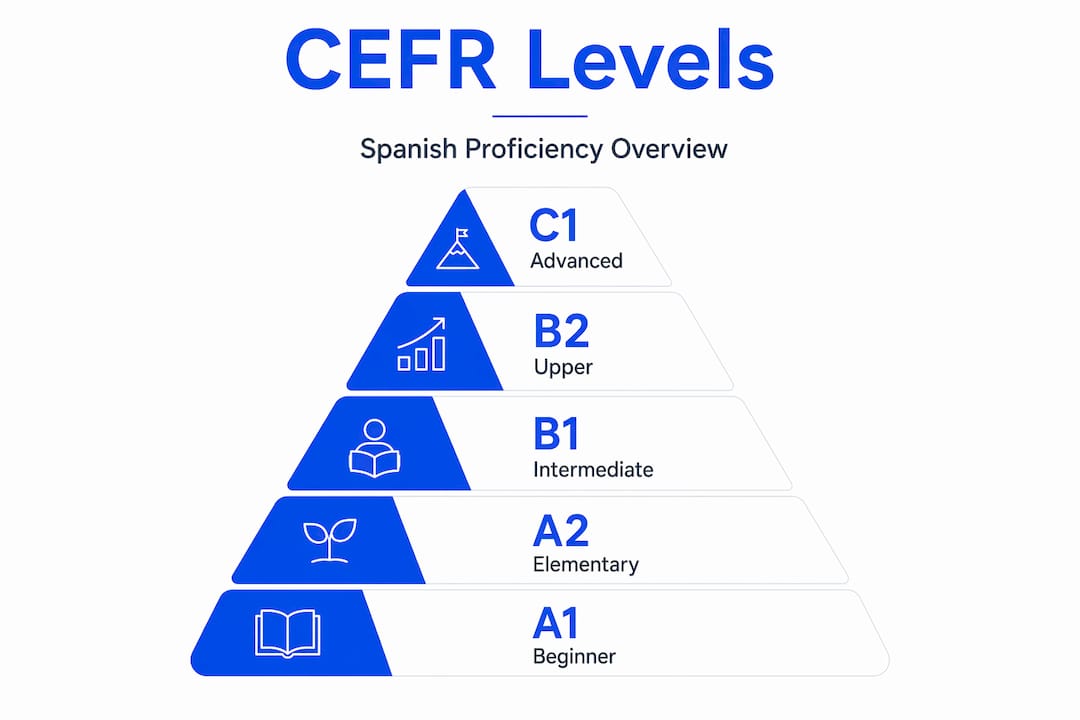
| CEFR level | Label | What you can do |
|---|---|---|
| A1 | Beginner | Introduce yourself, handle basic greetings and transactions |
| A2 | Elementary | Describe your environment, communicate in simple tasks |
| B1 | Intermediate | Handle most travel situations, express opinions on familiar topics |
| B2 | Upper-intermediate | Interact fluently with native speakers, understand complex texts |
| C1 | Advanced | Express ideas fluently and spontaneously for academic or professional use |
| C2 | Mastery | Understand virtually everything heard or read, express with precision |
A well-structured school maps its curriculum to these levels, so you always know where you stand and what comes next. For a detailed look at how courses are organized, the Spanish course syllabus breakdown provides a clear picture of what each stage covers.
Every quality Spanish class develops four core skills in parallel:
The DELE exam, for which the NUS Centre for Language Studies provides official exam information, tests all four of these skills. That is why choosing a class aligned to DELE standards from the start puts you in a much stronger position when exam time arrives.
Not all classes are created equal. The best programs share several qualities:
Now that you know what a class teaches, discover how official certification can elevate your Spanish to the next level. The DELE exam is issued by the Instituto Cervantes on behalf of Spain’s Ministry of Education, and it carries significant weight globally.
The DELE is accepted in over 100 countries, making it one of the most portable language credentials you can earn. Employers in multinational companies, universities in Spanish-speaking nations, and immigration authorities in several countries recognize DELE scores as definitive proof of Spanish ability.
Unlike course completion certificates, DELE is an external, standardized assessment. It cannot be inflated by a lenient teacher or a generous grading curve. When you show a hiring manager or admissions officer a DELE certificate, they know exactly what level of Spanish you have, verified by an independent body. That credibility is genuinely valuable in competitive job markets and university applications.
Pro Tip: Tell your Spanish instructor upfront that you are preparing for the DELE exam. A good teacher will adjust lesson content to mirror exam conditions, giving you a significant advantage over learners who only discover the exam format in the final weeks of preparation.
Statistic callout: The DELE certificate is recognized by governments, universities, and employers in more than 100 countries, making it one of the most internationally accepted language credentials available to Singaporean learners.
Here is something most language learning articles will not tell you directly: the class itself is only half the equation. The other half is what you do between sessions.
Many learners enroll in a well-structured course, attend every lesson, and still plateau after a few months. The reason is almost always the same. They treat Spanish as a classroom subject rather than a living communication tool. Vocabulary learned on Tuesday gets reviewed on the following Tuesday, which is simply too long a gap for retention.
The conventional wisdom that “any class will do as long as you show up” is genuinely flawed. Structure matters. Exam alignment matters. But consistent daily engagement with the language outside class matters just as much. Even fifteen minutes a day of reading Spanish news, watching a short video in Spanish, or reviewing vocabulary on a flashcard app compounds into significant gains over a semester.
We have seen learners with average aptitude outperform highly talented classmates simply because they built small daily habits around their coursework. Commitment, not raw talent, is the real predictor of success in language learning.
Singapore actually offers more opportunities for Spanish immersion than most people realize. The city hosts Spanish cultural events, Latin American business networking groups, and a growing community of Spanish-speaking expatriates. Engaging with these communities turns passive classroom knowledge into active, confident communication. A good starting point is exploring the Spanish learning resources available locally to supplement your class time.

The learners who progress fastest are those who treat their Spanish class as the foundation, not the ceiling. They use class time to build structure and accuracy, then use the world around them to build fluency and confidence. That combination is genuinely hard to beat.
You have learned what counts in a Spanish class. Now it is time to take action and find the format that fits your goals.
Spanish Explorer offers a full range of Spanish language courses in Singapore, from beginner group classes to advanced private tuition, all taught by certified, experienced instructors. Every course is structured around CEFR levels and aligned with DELE exam preparation, so your learning has a clear direction from day one. If your schedule demands flexibility, Spanish classes online are available to keep your progress moving regardless of where you are. Whether you are starting from scratch or targeting a specific DELE level, Spanish Explorer provides the structure, the instructors, and the support to get you there.
No, the DELE exam is optional, but it is widely recognized for academic and professional advancement. Learners pursuing formal credentials can find registration and exam details through the NUS Centre for Language Studies.
Beginner courses generally last eight to twelve weeks, depending on session frequency and the institution. Some intensive formats can cover the same material in a shorter period.
Yes, many Spanish classes are available online for Singapore learners, offering flexibility in timing and approach. Online formats work especially well as a complement to in-person group sessions.
Private classes are ideal for those needing personal attention, flexible scheduling, or tailored exam preparation. They are particularly effective for learners with specific DELE level targets or tight timelines.
You can find detailed DELE exam information and registration guidance at the NUS Centre for Language Studies website, which serves as the official examination center for Singapore candidates.
Book a trial class and see how quickly you can progress with a professionally trained native-speaker teacher guiding the way.
Book a Trial Class Spanish