Spanish pronunciation feels “fast” when you first listen to native speakers, but it’s far more regular than English. This Spanish pronunciation guide will walk you through the key sounds, stress rules, regional accents, and practical drills you need to pronounce Spanish words correctly and confidently.
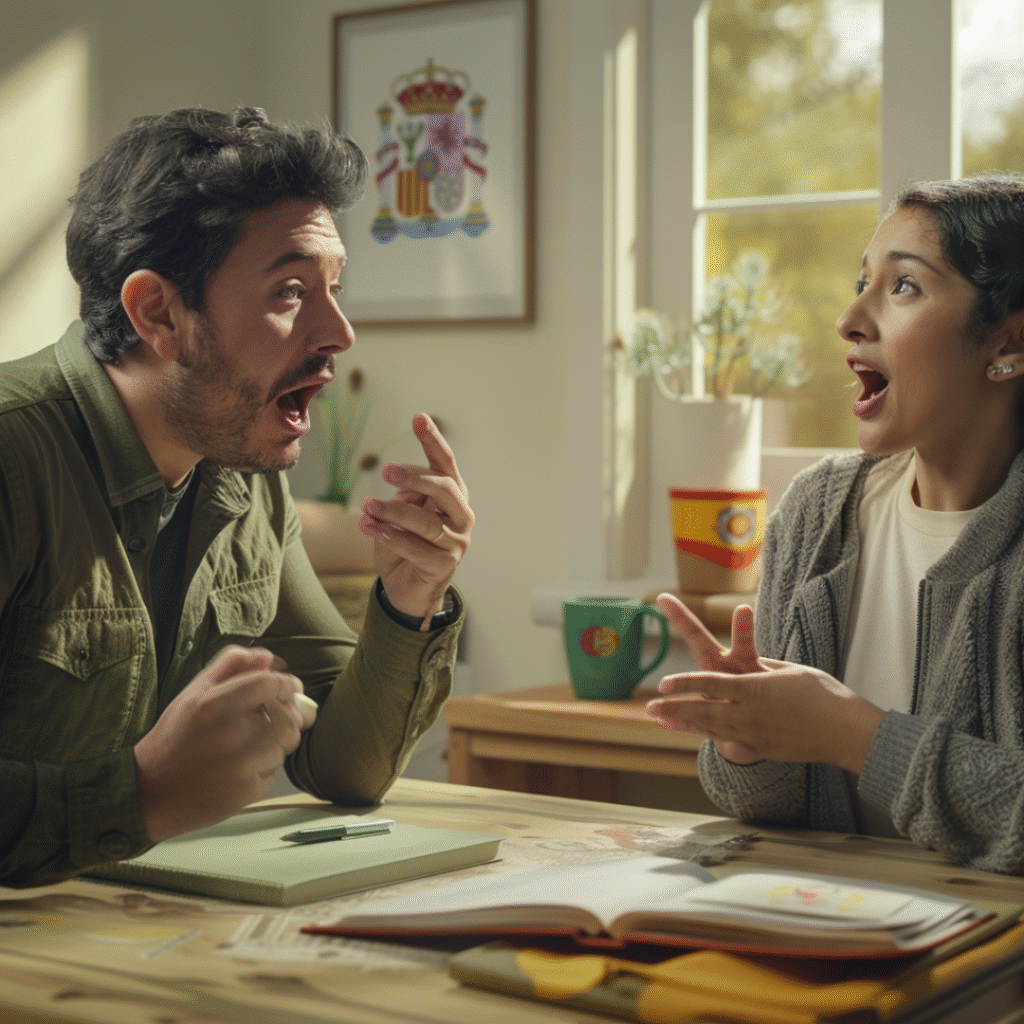
Spanish is often described as a phonetic language: in most cases, words are pronounced the way they’re written. Once you know what each letter (or letter pair) usually sounds like, reading and speaking become much more predictable.
Compared to English, Spanish has:
Why this matters for beginners:

Spanish has five pure vowels, each with one core sound regardless of stress:
Key difference from English:
In Spanish, vowels don’t change into other sounds. English learners often want to “slide” or “reduce” vowels; Spanish keeps them short, crisp and stable, even when unstressed.
A good beginner rule:
If you catch yourself saying “uh” anywhere, you’re probably inserting an English schwa that doesn’t exist in Spanish.
Spanish forms many natural diphthongs – two vowels pronounced in one syllable:
Be careful with eu, which doesn’t match a common English sound.
English speakers typically:
A simple drill:
Say café, amigo, tomate slowly, exaggerating vowels: ca-FÉ, a-MI-go, to-MA-te — no “uh”, no sliding.
Many consonants — f, l, m, n, p, s, t — are close to English, though t and d touch the upper teeth rather than the alveolar ridge, giving them a softer sound.
Let’s focus on the letters that cause most pronunciation problems.
In modern Spanish, b and v are pronounced the same:
This is why many native speakers write or say vaca and baca identically.
Spanish learners must understand hard vs soft c, plus regional seseo / ceceo:
For beginners, it’s perfectly fine to use Latin American seseo (all c/z before e/i pronounced like “s”), unless you specifically want a Castilian accent.
g has two main sounds:
j is pronounced as a raspy, voiceless velar fricative — like a strong h or the “ch” in Scottish “loch”: jamón, mujer.
The intensity varies: generally stronger in central/northern Spain, softer in much of Latin America.
This phenomenon is called yeísmo, and it’s now the majority pattern in the Spanish-speaking world.
This is the sound that scares most beginners — but it’s trainable.
Think of purring like a cat or imitating a motorcycle — the tongue vibrates against the ridge behind the top teeth.The tap (single r) and trill (rr) are signature features of Spanish and may require focused tongue-movement training, often reinforced through guided speaking exercises found in many Spanish learning resources.
Spanish uses predictable stress rules plus written accent marks (tilde) to show exceptions.
In words without a written accent:
The acute accent (´) marks the syllable that breaks the default rule or distinguishes meaning:
Crucially, the accent mark does not change the vowel quality or length — it only shows stress.
Spanish grammar and pronunciation resources divide words into four groups:
If you learn these four categories, reading Spanish aloud becomes much more intuitive.
Confusing ñ and n can create unfortunate misunderstandings:
Pay attention to the ny sound and practice with minimal pairs.
Saying jamón with an English “j” (dʒ) instead of the Spanish raspy [x]. The same error appears with g before e/i (gente, gimnasio).
Not tapping or rolling r makes pero and perro sound identical. Practice the tap first (quick D/T sound), then build up to the trill.
These components are typically included in many Spanish online classes designed for adults.
You don’t need to master every accent, but knowing the big patterns helps you choose a model and understand what you hear.
Pronunciation of c/z/s differs by region:
For most learners (and especially for global communication), seseo is the easiest model: treat soft c and z as “s”.
In large parts of Spain and Latin America, ll and y merge (yeísmo): both are pronounced like “y” in “yes”. In Rioplatense Spanish (Argentina/Uruguay), the same letters often sound like “sh” or “zh”.
As a beginner, choose an accent you’re most likely to interact with — for example Latin American Spanish if you’re studying in Singapore or dealing with Latin American markets — and model your pronunciation on that variety.
Good pronunciation doesn’t come just from reading rules; it comes from listening, repeating, and getting feedback.
The Mimic Method and other phonetics-based courses emphasise learning Spanish “by ear” first: listen to native audio, then copy rhythm, pitch and mouth shapes as closely as possible.
Practical steps:
Use minimal pairs (words that differ by one sound) to train your ear and mouth:
Tongue-twisters like “R con R cigarro, R con R barril…” are classic for building the rolled R.
Record yourself reading a short text, then compare it to native audio from a course or podcast. This is standard practice in accent reduction for adults and works very well at CEFR A2–B1 level.
If you’re studying in a Spanish language school in Singapore, look for:
On your own, build a routine like:
That 25-minute block, done 3–4 times a week, makes a noticeable difference within a month.
Spanish pronunciation is not about sounding “perfectly native” from day one; it’s about building clear, consistent sounds that native speakers understand instantly. Because Spanish has a small set of stable vowels, relatively transparent consonant rules, and predictable stress patterns, it actually rewards focused work on vowel clarity, key consonant differences (r, j, g, c/z, ñ) and accent marks. By combining a solid understanding of these rules with regular listening-and-speaking drills, you’ll move from hesitant reading to confident speaking faster than you might expect. Whether you’re aiming for CEFR A2 survival skills or B2 conversational fluency, investing early in pronunciation will pay off in every conversation you have in Spanish.
If you’d like structured guidance from experienced native teachers, explore our Spanish courses in Singapore to strengthen your pronunciation with expert feedback and practice.
Back to all articlesBook a trial class and see how quickly you can progress with a professionally trained native-speaker teacher guiding the way.
Book a Trial Class Spanish