TL;DR:
- Multilingual instructors use multiple languages actively in the classroom to enhance language learning and cultural understanding. Their strategies, such as translanguaging and scaffolding, lead to significant academic and developmental benefits, including improved literacy and social skills. Effective support from leadership, policies, and resources is essential for maximizing their impact and creating inclusive learning environments.
Multilingual instructors are defined as educators who use two or more languages as active teaching tools, functioning as both linguistic and cultural mediators in the classroom. The role of multilingual instructors goes far beyond translation. They model language learning in real time, validate students’ home languages, and apply evidence-based methods like translanguaging and scaffolding to accelerate acquisition. Research confirms that this approach produces measurable gains in phonological awareness, metalinguistic skills, and student engagement. For educators and administrators, understanding how these instructors operate and what supports they need is the clearest path to building more effective, inclusive learning environments.
Multilingual instructors enhance language acquisition by using students’ existing linguistic knowledge as a foundation rather than a barrier. The most effective method they deploy is translanguaging, a practice where multiple languages are used fluidly within a single lesson to scaffold complex concepts. Translanguaging accelerates learning by bridging understanding actively rather than keeping languages isolated. Students grasp difficult grammar or vocabulary faster when they can connect new input to a language they already know well.
Scaffolding is the second core strategy. A multilingual instructor might introduce a concept in a student’s home language, then gradually shift to the target language as comprehension builds. This mirrors how scaffolding in teaching works across all instructional contexts: provide temporary support, then remove it as the learner gains independence. The result is reduced cognitive overload and faster vocabulary retention.
Research shows that multilingual learning strategies give students a 16% advantage in phonological segmentation accuracy. Phonological segmentation, the ability to break words into their component sounds, is a foundational reading and pronunciation skill. That advantage compounds over time, giving multilingual learners a structural edge in literacy development.
Three classroom practices that multilingual instructors use consistently include:
Pro Tip: Avoid the “monolingual habitus” trap by deliberately planning at least one cross-language activity per lesson. Even a five-minute vocabulary comparison between English and Spanish produces measurable gains in metalinguistic awareness.
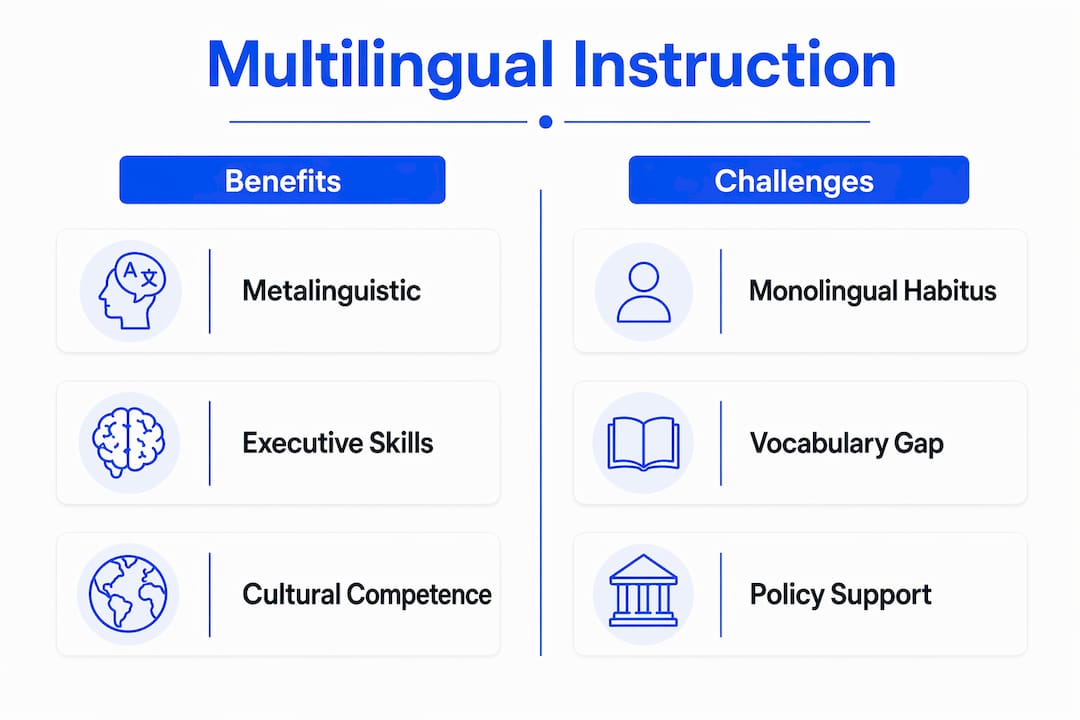
Multilingual instruction produces benefits that extend well beyond language proficiency. Interviews with 12 bilingual preschool educators confirm seven developmental benefits for students exposed to multilingual teaching: cognitive, social, identity, linguistic, emotional, psychological, and cultural. Each category represents a distinct area of growth that monolingual instruction does not address with the same depth.
Short-term vocabulary delays in multilingual learners are temporary and outweighed by long-term metalinguistic and executive function gains. Administrators who see early vocabulary gaps in multilingual programs should treat them as a transitional phase, not a program failure. The role of language diversity in teaching is to build a richer cognitive architecture, and that architecture takes time to construct.

The most significant barrier multilingual instructors face is the “monolingual habitus” embedded in many education systems. Monolingual habitus refers to the institutional assumption that one language of instruction is the default and that other languages are supplementary at best. A case study of the Italian education system found that training gaps and monolingual habitus produce minimal positive effects even when multilingual teachers are present. The problem is not the instructor’s ability. It is the system’s failure to prepare and support them.
A second challenge is reluctant multilingualism. When institutional policies do not explicitly support multilingual instruction, teachers default to the dominant language to avoid conflict or confusion. Research on English-medium instruction universities shows that reluctant multilingualism leads to burnout and less effective teaching. The fix is not motivation. It is policy clarity.
Common challenges multilingual instructors report include:
Pro Tip: When families raise concerns about early vocabulary gaps, share the research directly. Explaining that vocabulary delays are temporary transitions resolved as metalinguistic awareness strengthens turns a source of anxiety into a point of trust.
School leadership is the primary driver of effective multilingual instruction. Research confirms that leadership training increases classroom effectiveness and teacher empowerment in multilingual programs. Principals and department heads who understand multilingual pedagogy make better resource decisions, set clearer expectations, and reduce the isolation that multilingual instructors often feel.
Multilingualism must be built into the curriculum as a core component, not treated as an add-on. When multilingualism is integral to curriculum, instructors have the institutional backing to use translanguaging without fear of pushback. They can request multilingual materials, propose cross-language assessments, and collaborate with colleagues on language-inclusive lesson design. That structural support is what separates programs that produce results from programs that stall.
The table below summarizes the leadership actions that have the greatest impact on multilingual instruction outcomes.
| Leadership action | Impact on multilingual instruction |
|---|---|
| Provide targeted professional development | Equips instructors with translanguaging and scaffolding skills beyond basic language training |
| Establish clear language-use policies | Reduces reluctant multilingualism and gives instructors confidence to use all languages strategically |
| Supply multilingual classroom materials | Removes the burden of resource creation from individual teachers and standardizes quality |
| Appoint language mediators or coaches | Supports instructors in real time and models best practices for the wider teaching team |
| Include multilingualism in curriculum design | Signals institutional commitment and integrates language diversity as a learning asset |
Administrators who treat multilingual instruction as a staffing decision rather than a program design decision consistently underperform. The role of native-speaking instructors within a well-designed multilingual program is powerful, but only when leadership provides the framework for that expertise to operate effectively.
Multilingual instructors produce the strongest outcomes when translanguaging, institutional policy, and leadership support work together as a unified system.
| Point | Details |
|---|---|
| Translanguaging accelerates acquisition | Using multiple languages fluidly in lessons scaffolds complex concepts and reduces cognitive overload. |
| Seven developmental benefits confirmed | Multilingual instruction improves cognitive, social, identity, linguistic, emotional, psychological, and cultural development. |
| Early vocabulary gaps are temporary | Short-term deficits of 12–18% resolve as metalinguistic awareness strengthens over time. |
| Monolingual habitus is the core barrier | Institutional assumptions about single-language instruction limit multilingual teaching even when skilled instructors are present. |
| Leadership drives program success | Principals who invest in training, policy, and resources produce measurably better multilingual instruction outcomes. |
I’ve spent years observing language programs across different institutional settings, and the pattern is consistent. The programs that struggle are not struggling because their instructors lack skill. They struggle because leadership treats multilingualism as a nice-to-have rather than a design principle.
The most common misconception I encounter is that a multilingual instructor’s job is to translate. It is not. Translation is a last resort. The real work is building a classroom environment where students feel safe moving between languages, where that movement is treated as evidence of thinking rather than evidence of confusion. That shift in framing changes everything about how students engage.
What surprises administrators most is how quickly the results appear once the right supports are in place. When instructors have clear policies, relevant materials, and a principal who understands the pedagogy, student participation increases within weeks. The group learning environment becomes self-reinforcing. Students start modeling multilingual behavior for each other.
The uncomfortable truth is that most professional development programs for multilingual instructors are too shallow. A one-day workshop on translanguaging does not change classroom practice. What changes practice is sustained coaching, peer observation, and a leadership team that asks the right questions in evaluation conversations. Administrators who want better outcomes should audit their professional development investment before they audit their instructors.
— Paul
Spanish Explorer offers adult Spanish courses in Singapore designed for educators and professionals who want to build real communication skills in a multilingual context.

Whether you prefer online Zoom classes or in-person sessions at International Plaza above Tanjong Pagar MRT, Spanish Explorer’s experienced native instructors bring multilingual teaching expertise to every lesson. Group classes, private sessions, and corporate Spanish training are all available. The curriculum focuses on conversational fluency and business communication, not rote memorization. Visit the Spanish courses page to review current options or book a trial class.
Multilingual instructors serve as linguistic and cultural mediators who use translanguaging and scaffolding to accelerate language acquisition. They model multilingual behavior, validate students’ home languages, and build metalinguistic awareness that supports long-term academic success.
Translanguaging is a deliberate instructional practice where multiple languages are used fluidly to scaffold understanding, while code-switching is an informal, often unconscious shift between languages. Translanguaging is planned and purposeful; code-switching is reactive.
Research confirms a 12–18% short-term vocabulary deficit in some early multilingual learners, but this gap is temporary. Long-term gains in metalinguistic awareness and executive function consistently outweigh the early deficit.
Multilingual instructors need clear language-use policies, targeted professional development in translanguaging and scaffolding, multilingual classroom materials, and leadership that treats language diversity as a curriculum asset rather than a logistical challenge.
Qualitative research from five state schools shows that three-language strategies produce better student engagement and inclusivity than bilingual approaches alone. Adding a third language increases the range of students who feel represented and supported in the classroom.
Book a trial class and see how quickly you can progress with a professionally trained native-speaker teacher guiding the way.
Book a Trial Class Spanish