TL;DR:
- Group Spanish classes provide real-time conversation practice and social motivation.
- They follow structured curricula aligned with CEFR levels, led by qualified native teachers.
- They are cost-effective, enhance fluency, and suit learners seeking ongoing, interactive language development.
Many people assume learning Spanish means sitting alone with textbooks or paying for one-on-one private tutoring. That assumption leaves a powerful option off the table. Group Spanish classes offer something neither solo study nor private lessons can fully replicate: the energy, accountability, and real-time conversation practice that comes from learning alongside other people. In Singapore, where multilingualism is already part of daily life, group classes fit naturally into how people here learn and grow. This article breaks down what a group Spanish class actually is, the benefits it delivers, how it compares to private lessons, and what to look for when choosing the right course.
| Point | Details |
|---|---|
| Collaborative learning | Group Spanish classes foster peer interaction for greater motivation and fluency. |
| Expert-led curriculum | Accredited, native-speaking teachers ensure quality and structured progress. |
| Tailored to Singapore | Group offerings suit a range of learner goals, from travel to career advancement. |
| Clear comparison | Group vs. private class distinctions help you choose the best fit for your needs. |
A group Spanish class is a structured learning session where several students study together under the guidance of a qualified instructor. Unlike self-study apps or informal conversation meetups, group classes follow a defined curriculum with clear learning outcomes at every stage.
In Singapore, most group Spanish classes run with 6 to 12 students per session. That size is intentional. Small enough that every student gets meaningful interaction with the teacher, large enough to create the kind of conversational dynamics that make language learning stick. Sessions typically run between 90 minutes and 2 hours, meeting once or twice a week depending on the school and course level.
Courses are structured around internationally recognized frameworks. The CEFR (Common European Framework of Reference for Languages) is the standard most reputable schools use. It defines six levels from A1 (complete beginner) to C2 (mastery), giving students a clear progression path and a credential that employers and universities worldwide recognize. Schools that align their curriculum to CEFR ensure you are not just picking up casual phrases but building a real, measurable foundation in the language.
The teaching style in group classes at quality institutions emphasizes active participation. Students practice speaking, listening, reading, and writing within every session, not just grammar drills. Established schools like Spanish World, Lingo, and Spanish Studio use native teachers to deliver this kind of structured, immersive instruction.
Here is a quick look at what group Spanish classes in Singapore typically look like:
| Feature | Typical standard |
|---|---|
| Class size | 6 to 12 students |
| Session length | 90 to 120 minutes |
| Levels offered | A1 to C1 (CEFR aligned) |
| Teacher qualification | Certified, native or near-native speaker |
| Location | Central Singapore or online |
| Curriculum framework | CEFR / DELE aligned |
“The best group classes feel less like a lecture and more like a guided conversation. You are always doing something with the language, not just watching someone explain it.”
This structure is what separates a quality group class from a casual language exchange. You get professional instruction, a clear roadmap, and the social environment that makes practice feel natural.
Group classes have grown in popularity across Singapore for good reason. The format delivers advantages that go well beyond simple cost savings.
Collaborative practice builds real fluency. When you practice Spanish with classmates, you are doing what the language is actually for: communicating with other people. You hear different accents, different pacing, and different ways of expressing ideas. That variety accelerates your ear training and makes you more adaptable in real conversations. Group settings are often more engaging and supportive, leveraging peer interaction for rapid improvement.
Here are the core benefits group Spanish classes offer:
For learners in Singapore pursuing Spanish for career advancement, understanding why learn Spanish in a professional context matters. Spanish is the second most spoken language in the world by native speakers, and companies with Latin American or Spanish market exposure actively seek employees who can communicate in it. Group classes give you the structured foundation to get there.
For personal enrichment, the social dimension of group learning adds genuine enjoyment to the process. You build friendships alongside vocabulary.

Pro Tip: Treat your classmates as practice partners outside of class. A 10-minute WhatsApp voice note exchange in Spanish between sessions can double your speaking confidence within weeks.
The group class advantages become especially clear when students hit the intermediate plateau, that frustrating stage where progress feels slow. Group dynamics and peer encouragement are often what push learners through it.
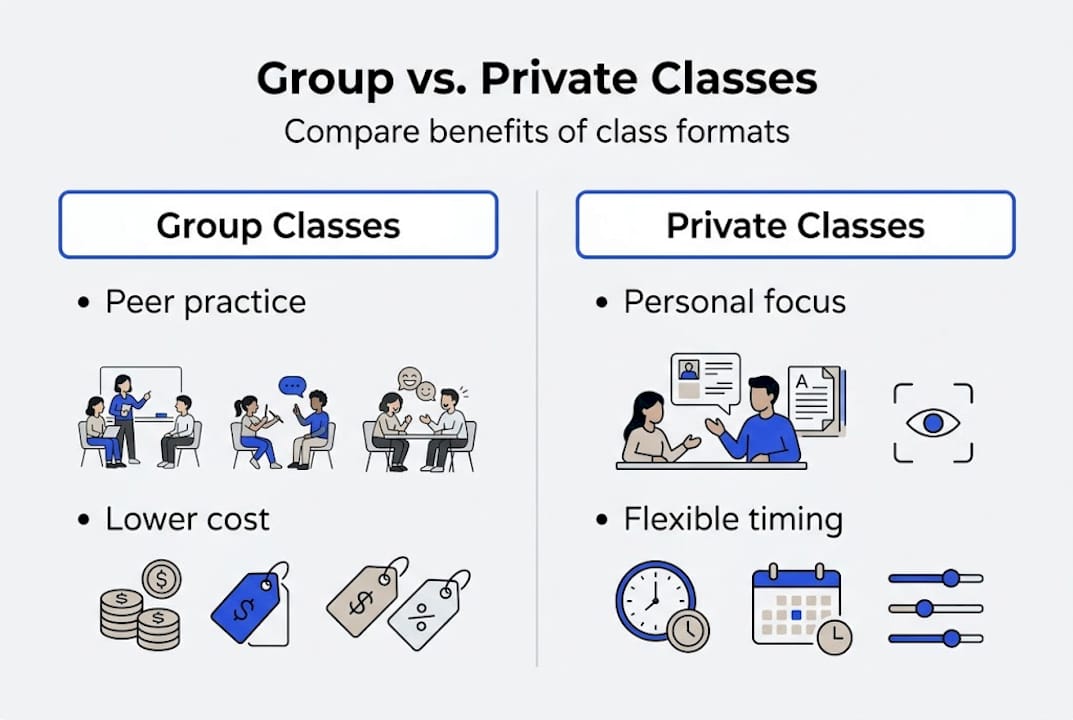
Both formats have real merit. The right choice depends on your specific goals, schedule, and how you learn best. Spanish language schools in Singapore offer both group and private options, each with distinct strengths.
Here is a direct comparison:
| Factor | Group classes | Private classes |
|---|---|---|
| Cost per hour | Lower | Higher |
| Schedule flexibility | Fixed timetable | Highly flexible |
| Personal attention | Shared with group | Fully individualized |
| Conversation practice | High (peer interaction) | Limited to teacher |
| Progression pace | Group-set pace | Your pace |
| Social motivation | Strong | Low |
Private Spanish classes make sense when you have a very specific, narrow goal, like preparing for a job interview in Spanish next month, or when your schedule makes fixed class times impossible. Private lessons also suit learners who have significant gaps in their foundation and need targeted remediation before joining a group.
Group classes work best when you want consistent, affordable progress with built-in social motivation. They are ideal for learners at any level who want to build conversational fluency over time.
Follow these steps to decide which format fits you:
Browsing group Spanish courses in Singapore will give you a clear sense of what levels, schedules, and formats are available before you commit.
Not all group classes are equal. Knowing what separates a quality program from a mediocre one saves you time, money, and frustration.
Here are the key criteria to evaluate before enrolling:
The native Spanish teachers at reputable schools bring cultural context that textbooks cannot. They teach you how Spanish is actually spoken in Mexico City, Madrid, or Buenos Aires, not just grammatically correct sentences.
Pro Tip: Always ask whether the school offers a trial class before you commit to a full course. A single session tells you more about teaching quality and class dynamics than any brochure. Also ask how the school measures your progress from level to level.
When you learn Spanish in Singapore through an accredited institution, you also gain access to internationally recognized certification pathways like DELE, which can strengthen your academic or professional profile significantly.
There is a persistent belief in language learning circles that private lessons are the fast track and group classes are the budget compromise. We think that framing is wrong, and the evidence from classroom experience supports a different view.
Real language mastery happens in conversation, not in isolation. A private lesson gives you one conversation partner: your teacher. A group class gives you five to eleven. That means more speaking turns, more listening practice, and more exposure to the kinds of misunderstandings and repairs that make communication skills durable.
Group energy also does something private lessons cannot manufacture: it creates low-stakes pressure. When a classmate asks you a question in Spanish and you have to respond in real time, you are practicing the exact cognitive skill that fluency requires. You cannot pause, rewind, or ask the teacher to slow down. You adapt. That adaptation is where real learning happens.
In Singapore specifically, multicultural classrooms add another layer of richness. When your classmates come from different linguistic backgrounds, Filipino, Chinese, Indian, Malay, the group naturally surfaces different ways of thinking about grammar and meaning. Those collisions of perspective deepen everyone’s understanding.
The student group experiences we see consistently show that learners who stay in group classes longer develop more natural, confident Spanish than those who switch exclusively to private lessons early. The group is not a stepping stone. For many learners, it is the destination.
If this article has shifted how you think about group learning, the next step is simple: see it for yourself.

At Spanish Explorer, we offer current Spanish group courses across all CEFR levels, from complete beginners to advanced speakers. Our classes are led by certified, native-speaking instructors in a structured environment designed to build real communication skills. You can also book a trial class to experience our teaching approach before committing to a full course. With flexible schedules and small class sizes, there is a group that fits your life. Come find your place in it.
Most group Spanish classes in Singapore have 6 to 12 students, ensuring personal attention alongside group interaction. Small class sizes are a hallmark of trusted Spanish schools in the city.
Yes, accredited Spanish schools in Singapore use native-speaking instructors for group classes. Native teachers are a standard feature at reputable institutions, bringing both linguistic accuracy and cultural depth to every session.
Look for classes at institutions accredited by Cervantes or aligned to CEFR standards for quality assurance. Spanish World is Cervantes accredited and aligns with CEFR levels, which is a useful benchmark when evaluating any school.
Yes, many group classes follow syllabi aligned with DELE and SIELE exam requirements. Group classes at established schools are aligned to international exam frameworks, making them a solid foundation for formal certification.
Most reputable Spanish schools in Singapore offer trial classes for new students. Trial classes are a commonly available feature that lets you assess teaching quality and group dynamics before enrolling in a full course.
Book a trial class and see how quickly you can progress with a professionally trained native-speaker teacher guiding the way.
Book a Trial Class Spanish