TL;DR:
- Structured Spanish curricula use spiral design and integration to reinforce vocabulary and grammar, leading to faster, longer-lasting learning. Active retrieval through guessing and immediate feedback deepens language acquisition more effectively than passive review or isolated practice. Proper placement and goal-aligned syllabus planning ensure steady progress toward exam, professional, or conversational fluency objectives.
Most learners assume that making mistakes means falling behind. But guessing before feedback actually improves long-term memory more than passive study does. That is the core insight behind why choose structured Spanish curriculum matters so much for Singapore professionals and adult learners. A well-built curriculum does not just deliver content. It engineers the learning sequence so that each lesson reinforces what came before and prepares you for what comes next. This guide walks you through the science, the structure, and the practical decisions that will determine how fast and how well you actually learn Spanish.
| Point | Details |
|---|---|
| Spiral learning design | Revisiting grammar and vocabulary repeatedly helps make knowledge stick long term. |
| Active retrieval matters | Guessing before feedback strengthens memory better than passive studying. |
| Correct placement is crucial | Starting at the right level prevents gaps that slow down future progress. |
| Tailored goals improve outcomes | Structured courses can focus on conversational, business, or exam skills effectively. |
| Continuous practice wins | Using Spanish daily outside class turns structured learning into real fluency. |
Random vocabulary apps and YouTube lessons give you fragments. A structured Spanish curriculum gives you a system. The difference shows up within weeks, not years.
The most effective curricula use a spiral design. That means grammar and vocabulary are recycled at increasing levels of complexity, not introduced once and forgotten. You meet the verb ser (to be) at A1 in simple identity sentences. By B1, you are using it to discuss abstract characteristics. The concept deepens without the cognitive load of starting from scratch each time.
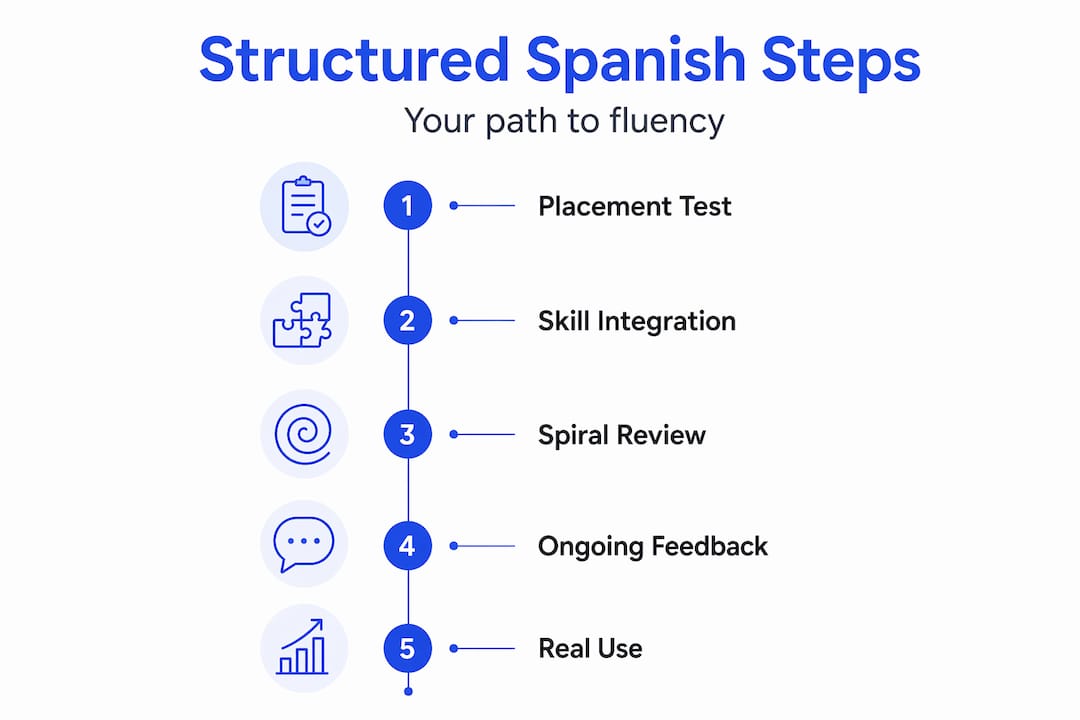
Integration is the other critical piece. Strong curricula connect reading, listening, speaking, and writing through shared themes rather than treating each skill as a separate subject. When you read a passage about a business meeting in Spanish, then discuss it out loud, then write a follow-up email using the same vocabulary, you are building layered, accessible knowledge, not surface recall.
Benefits of a spiral, integrated curriculum:
“Structured curricula recycle key grammar and vocabulary in a spiral progression and plan speaking and writing opportunities that strengthen retrieval and retention.” — Professor Jack C. Richards
The result is that knowledge becomes accessible under pressure, the exact condition you face in a business meeting, a travel situation, or a DELE (Diploma de Español como Lengua Extranjera, the internationally recognized Spanish certification exam) oral exam.
Pro Tip: Ask any Spanish program you are considering whether their curriculum is skill-integrated or skill-siloed. If listening, speaking, reading, and writing are taught as separate units with no connecting themes, that is a red flag.
The structured teaching style at Spanish Explorer applies this spiral, integrated approach from the very first lesson, so every class builds directly on the last.
Here is something most language schools do not advertise: the discomfort of not knowing the answer is actually doing cognitive work for you.
Pretesting with guessing before receiving correction activates stronger mental encoding than reviewing material you already recognize. When your brain attempts an answer and gets it wrong, it creates a retrieval gap. The correction that follows fills that gap more deeply than if you had simply read the right answer from the start.
Structured Spanish lessons apply this principle deliberately. Here is how it works in a well-designed course:
This is why passive review methods, reading notes, re-watching videos, highlighting textbooks, consistently underperform active retrieval in language learning research. You remember what you had to work to produce.
For Singapore professionals studying Spanish alongside full-time careers, this efficiency matters enormously. Less time, more retention. You can explore efficient Spanish learning workflows to see how this applies in online settings as well.
Pro Tip: When you study vocabulary outside class, test yourself by covering the translation and trying to recall it first. Even getting it wrong strengthens the memory trace. Looking up the answer immediately after every guess defeats the purpose.
Knowing how structured learning works is useful. Knowing where you fit in that structure is what makes it actually work for you.

Proper placement is not a formality. It is the difference between building on a solid foundation and papering over cracks that will widen at every advanced level. Skipping placement or levels without assessment creates gaps that compound over time, a costly mistake for adult learners in Singapore who have real deadlines, career goals, or exam dates.
What a well-aligned syllabus does for you:
Here is how the CEFR levels and their practical focus break down:
| CEFR level | Label | Practical focus |
|---|---|---|
| A1 | Beginner | Basic introductions, numbers, everyday phrases |
| A2 | Elementary | Simple conversations, past tense, travel situations |
| B1 | Intermediate | Opinions, work topics, longer narratives |
| B2 | Upper intermediate | Professional communication, abstract topics |
| C1 | Advanced | Nuanced writing, academic and business fluency |
| C2 | Mastery | Near-native precision and cultural depth |
Rushing from A2 to B2 without completing B1 is like building the third floor of a house before the second floor walls are load-bearing. It feels faster until everything starts shifting.
Pro Tip: Before enrolling anywhere, ask to see the syllabus by level. A good program shows you exactly which grammar points, vocabulary themes, and skills each level covers. Vague descriptions like “intermediate topics” are not enough.
Knowing which exam level fits your current skills is just as important as the course itself. See our guide to choosing DELE exam levels before you commit to an exam date.
Not every learner in Singapore is chasing the same outcome. A financial analyst who needs to communicate with Latin American clients has different priorities than someone preparing for a DELE B2 exam or a traveler planning an extended stay in Spain. The good news is that the advantages of structured Spanish learning apply across all of these goals. The structure simply gets pointed in a different direction.
Here is how course focus compares by goal:
| Goal | Core skill emphasis | Curriculum priority |
|---|---|---|
| Conversational fluency | Speaking, listening | Practical vocabulary, real dialogues |
| Business communication | Writing, speaking | Formal register, industry terms |
| DELE certification | All four skills | Exam task formats, timed practice |
| Travel and culture | Speaking, listening | Informal register, cultural context |
| Academic Spanish | Reading, writing | Grammar precision, academic vocabulary |
The global language education review from ACTFL confirms that high-quality language education leads to competency in communication, cultural understanding, and the global marketplace. For Singapore professionals, that last point is increasingly relevant as trade and investment ties with Latin America deepen.
What a goal-aligned structured curriculum includes:
The structured approach to learning Spanish does not restrict your goals. It channels your effort toward them more precisely.
Choosing the wrong course does not just slow you down. It can actively create bad habits that become harder to fix at higher levels. Here are the mistakes that come up most often among adult learners in Singapore.
Pro Tip: Before signing up, ask whether the course includes a formal mid-course and end-of-course assessment. Programs that skip formal evaluation have no reliable way to tell you whether you are actually ready to advance.
If you are deciding between international certification options, the DELE vs SIELE exam guide breaks down exactly which exam fits which goal and why the distinction matters for professionals.
Here is the uncomfortable truth about language learning in Singapore: the learners who make the fastest progress are not always the most talented. They are the ones who stopped treating the syllabus as a constraint and started using it as a map.
Most adults skip placement or resist foundational courses for a simple reason: they want to save time. The logic feels sound. Why sit through A1 if you already know some Spanish from a holiday or an app? The problem is that informal exposure rarely builds the grammatical scaffolding that advanced communication requires. The gaps are invisible at first and expensive later.
The more productive mindset is to treat the syllabus as a framework you build on, not a ceiling that limits you. Learners who approach the syllabus this way advance faster and sustain their skills longer. They move through levels with confidence because each level was fully consolidated, not skimmed.
The other factor most learners underestimate is what happens outside the classroom. Structured curricula are powerful. But they cannot do all the work. Consistent exposure between lessons, watching Spanish content, speaking with conversation partners, reading real Spanish text, is what converts structured knowledge into fluid ability. The curriculum builds the architecture. Your habits between classes fill it in.
The biggest gains we see at Spanish Explorer come from learners who do two things: they accept corrective feedback without embarrassment, and they apply what they are learning outside the classroom before the next session. Both habits take deliberate practice. But once they are in place, progress accelerates in ways that pure classroom time cannot replicate.
You can start building those habits immediately by following the structured path to fluency that combines deliberate curriculum design with real-world application from day one.
Now that you understand why structure matters, here is how to put it into practice at a school built specifically for learners in Singapore.
At Spanish Explorer, our structured Spanish courses are designed around spiral progression, integrated skill practice, and real-world language use, the same principles this article covers. Every learner starts with a placement consultation so you begin at the level that matches your actual ability and goals, not just your confidence. We offer group classes, private sessions, and online Spanish classes via Zoom, giving you flexibility without sacrificing structure. Specialized tracks cover conversational Spanish, business communication, and DELE exam preparation courses with instructors who are both certified and fluent in English. Walk-ins and consultations are welcome at our center at 10 Anson Road, Level 22, International Plaza, Singapore.
A structured curriculum systematically recycles grammar and builds in speaking and writing practice at every stage, producing stronger long-term retention and real-world skills that self-directed apps cannot reliably deliver.
Guessing before feedback activates stronger mental connections because the brain works harder to fill the retrieval gap, making the corrected answer stick more deeply than passive review ever could.
Skipping levels without assessment creates invisible gaps in grammar and vocabulary that compound at higher levels, making advanced material harder to absorb and slowing overall progress significantly.
Take a formal placement test and review the syllabus topics by level to match your current skills with the right CEFR benchmark before committing to an exam date.
Yes, provided they integrate all four skills through real-world tasks and include interactive speaking and writing practice with prompt, specific feedback from a qualified instructor.
Book a trial class and see how quickly you can progress with a professionally trained native-speaker teacher guiding the way.
Book a Trial Class Spanish