TL;DR:
- Learning Spanish in 2026 enhances brain health, professional prospects, and cultural immersion through consistent practice. Bilingual adults delay dementia onset, earn higher salaries, and access richer travel experiences, making it a highly valuable skill. Structured adult courses and daily practice accelerate proficiency, with now being the ideal time to start.
Studying Spanish in 2026 is a strategic investment in your brain health, career prospects, and cultural reach. With over 500 million native and second-language speakers worldwide, Spanish ranks as the second most spoken language on the planet by total users. Whether you are pursuing professional growth, planning extended travel across Latin America or Spain, or simply want a sharper mind, the reasons to study Spanish this year are more concrete than ever. Tools like Duolingo, Babbel, and structured classroom programs at schools like Spanish Explorer make starting easier than at any previous point in history.
The personal and cognitive rewards of learning Spanish are backed by hard neuroscience, not motivational clichés. Bilingual individuals develop dementia symptoms 4.5 years later than monolinguals on average, a delay attributed to the cognitive reserve built by managing two language systems simultaneously. That single finding reframes Spanish study from a hobby into a long-term health strategy.
The brain benefits extend well beyond dementia prevention. Regular Spanish practice strengthens executive function, the mental system responsible for focus, task-switching, and working memory. Adults who practice consistently show measurable gains in cognitive flexibility, which translates directly into better problem-solving at work and sharper attention in daily life.
Here is what the research shows about building those benefits effectively:
Pro Tip: Build your daily Spanish practice around a fixed time slot, such as your morning commute or lunch break, to make consistency automatic rather than effortful.
The importance of Spanish language in 2026 is not just cultural. It is neurological. Every session you complete is a deposit into a cognitive reserve that pays dividends decades from now.
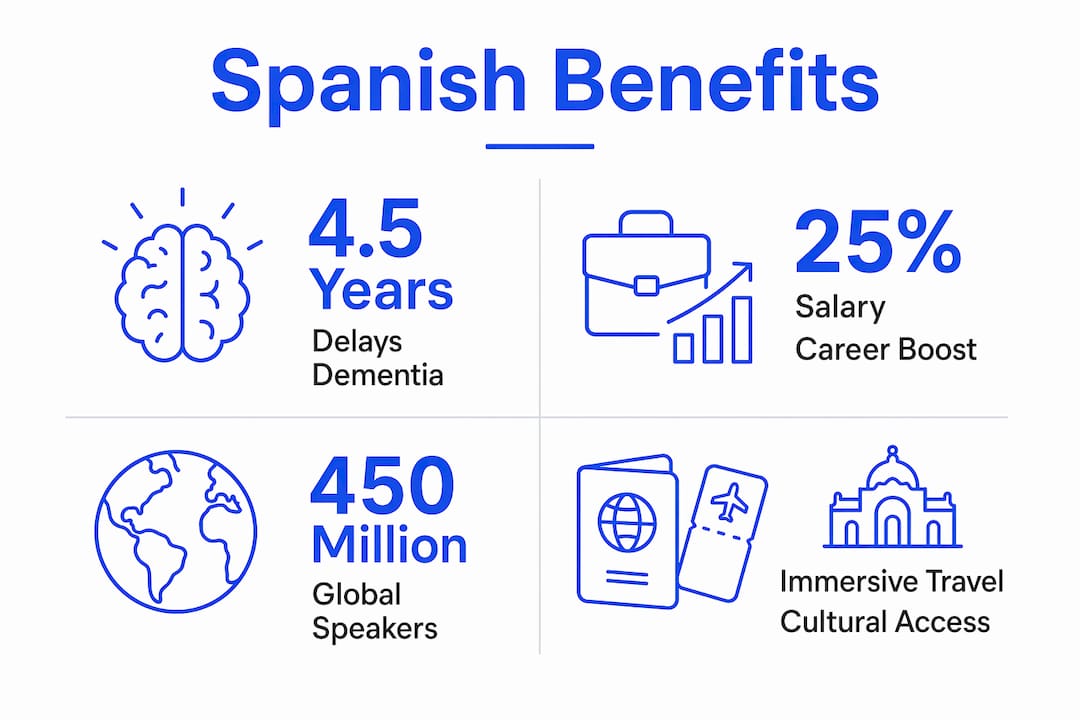
Spanish is one of the most commercially valuable languages on earth, and the professional case for bilingualism in 2026 has never been stronger. The Spanish-speaking world spans 20 countries, includes the United States as the second-largest Spanish-speaking nation by population, and covers major economies across Latin America that are growing faster than many Western markets.

Bilingual employees earn a salary premium of 5% to 20% above their monolingual peers, depending on role and industry. That premium reflects genuine market demand. Employers in healthcare, education, tourism, marketing, and financial services are actively recruiting candidates who can communicate across language lines.
The industries where Spanish proficiency creates the clearest career advantage in 2026 are:
Beyond salary, Spanish proficiency signals cultural competence. In a global hiring market, the ability to work across cultures is a differentiator that no certification can fully replicate. Learning Spanish is one of the most direct ways to demonstrate that competence to any employer.
Speaking Spanish transforms travel from a surface-level experience into genuine immersion. Travelers who speak Spanish can move beyond tourist zones, negotiate prices at local markets, ask for restaurant recommendations that never appear on TripAdvisor, and build real connections with people they meet.
The practical advantages compound quickly once you leave major cities. In rural Mexico, coastal Colombia, or the interior of Argentina, English is rarely spoken. A traveler with even intermediate Spanish can navigate transportation, handle medical situations, and participate in local life in ways that a non-speaker simply cannot.
Consider what Spanish proficiency actually unlocks:
Pro Tip: Before any trip to a Spanish-speaking country, spend two weeks focusing specifically on the regional dialect of your destination. Mexican Spanish and Castilian Spanish share a core, but vocabulary differences can cause real confusion in everyday situations.
The benefits of learning Spanish for travel in 2026 are not abstract. They are the difference between visiting a place and actually experiencing it.
Spanish is widely recognized as one of the most learnable languages for English speakers, and the structural reasons for that are worth understanding. Over 40% of Spanish vocabulary shares cognates with English, meaning words like “hospital,” “natural,” “important,” and “possible” are immediately recognizable. That built-in vocabulary head start is significant.
Spanish phonetics are also consistent. Unlike English, where spelling and pronunciation follow irregular rules, Spanish words are almost always pronounced exactly as they are written. This makes reading aloud and listening comprehension far more predictable for adult learners.
Adults also bring a motivational advantage that children lack. Strong intrinsic motivation is the single best predictor of long-term success in adult language learning. Adults choose to study Spanish for specific, meaningful reasons, whether for a promotion, a trip, or personal growth. That clarity of purpose drives consistency in ways that classroom obligation rarely does.
Here is a realistic comparison of learning approaches for adult Spanish learners in 2026:
| Learning method | Best for | Realistic timeline to conversational level |
|---|---|---|
| Structured group classes | Adults who want guided progression and peer practice | 6 to 12 months at consistent attendance |
| Private tutoring | Adults with specific goals or irregular schedules | 4 to 8 months with weekly sessions |
| Online Zoom courses | Adults balancing work and study commitments | 6 to 10 months with daily self-study |
| App-only learning (Duolingo, Babbel) | Supplement to structured study | Insufficient alone for conversational fluency |
| Corporate training programs | Teams needing business Spanish fast | 3 to 6 months for functional workplace use |
Adults achieve intermediate proficiency in months through deliberate practice, while children in immersion environments need years to reach comparable results. The adult advantage is real. It simply requires the right structure and a commitment to daily practice over cramming. Exploring adult learning pathways designed specifically for 2026 learners can help you choose the format that fits your life.
Learning Spanish in 2026 delivers measurable cognitive, professional, and cultural advantages that compound over time, making it one of the highest-return skills an adult can develop.
| Point | Details |
|---|---|
| Cognitive health protection | Bilingualism delays dementia onset by an average of 4.5 years through cognitive reserve. |
| Career salary premium | Bilingual employees earn 5% to 20% more than monolingual peers across multiple industries. |
| Travel depth | Spanish speakers access authentic local experiences that non-speakers cannot reach. |
| Adult learner advantage | Adults reach intermediate proficiency faster than children in structured settings. |
| Daily practice is the key | 15 to 30 minutes daily outperforms longer, irregular study sessions for retention and brain benefits. |
I have worked with adult language learners for years, and the single most common regret I hear is not “I started too late.” It is “I wish I had started sooner.” The people who say that are usually in their 40s or 50s, looking back at a decade of thinking about learning Spanish without acting on it.
Here is what I have actually observed: adults who commit to structured learning with a clear personal reason, whether it is a job opportunity, a relationship, or a trip they have been planning for years, progress faster than they expect. The first three months are the hardest. After that, the language starts to feel less like a foreign system and more like a second mode of thinking.
The cognitive science on this is clear. Consistent daily practice matters more than the method you choose or the number of hours you log in a single week. Fifteen focused minutes every morning will outperform a two-hour session on Sunday every single time. That is not motivational advice. It is how memory consolidation works.
What I would tell any adult considering Spanish right now is this: the language is genuinely accessible, the tools available in 2026 are better than they have ever been, and the reasons to learn, from brain health to career value to richer travel, are all real and well-documented. The only thing that does not work is waiting for the perfect moment. There is no perfect moment. There is only the decision to start.
— Paul
Spanish Explorer offers structured adult Spanish courses designed for exactly the kind of learner this article is written for. Whether you want conversational Spanish for travel, business Spanish for professional advancement, or corporate training for your team, the programs are built around real-world communication from the first lesson. Classes run online via Zoom and in person at 10 Anson Road, Level 22, International Plaza, Singapore 079903, right above Tanjong Pagar MRT. Explore the full range of adult Spanish courses to find the format that fits your schedule, or browse the experienced Spanish teachers available for private and group instruction.
Spanish is the second most spoken language in the world by total users, and demand for bilingual professionals is growing across healthcare, business, and technology sectors. The cognitive and career benefits documented by recent research make 2026 a strong year to commit.
Adults in structured group or private courses typically reach conversational proficiency within 6 to 12 months with consistent attendance and daily practice outside class. Adults using deliberate methods progress faster than children in comparable formal settings.
Spanish is one of the most accessible languages for English speakers. Over 40% of Spanish vocabulary shares cognates with English, and its phonetic spelling system makes pronunciation far more predictable than English.
Bilingual adults develop dementia symptoms an average of 4.5 years later than monolinguals. Regular Spanish practice also strengthens executive function, cognitive flexibility, and working memory in measurable ways.
Yes. Online Zoom-based courses with a certified instructor provide the structured feedback and accountability that app-only learning cannot replicate. Most adults reach a functional conversational level within 6 to 10 months through online instruction combined with daily self-study.
Book a trial class and see how quickly you can progress with a professionally trained native-speaker teacher guiding the way.
Book a Trial Class Spanish